How Trousers Should Fit.
How women's trousers should fit: hips, rise, waist gap, darts and hem length for flats or heels, plus what a tailor can fix and what to return.
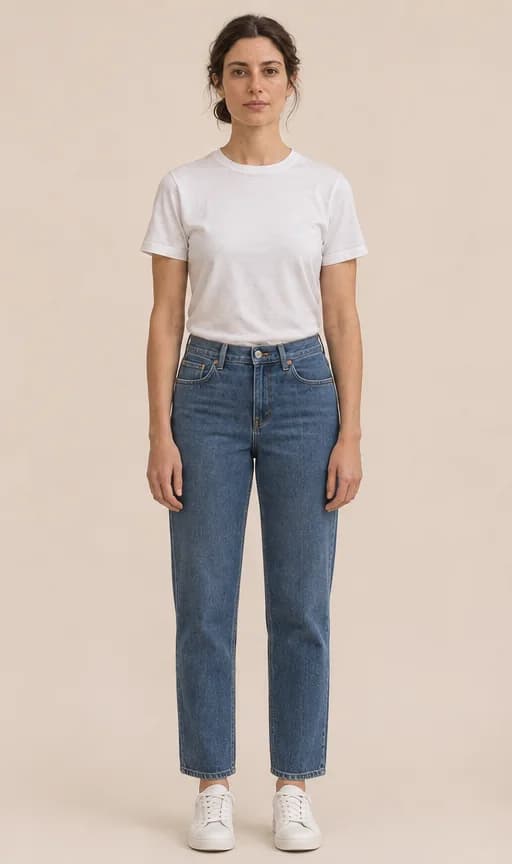
Right size: the waistband sits level, the seat and thighs drape without pulling or sagging, and the hem rests on the shoe with at most one soft fold.
The fit in 30 seconds.
Check these in order. The first ones are the hardest to alter.
- 01
Hips
The trousers skim the widest part of your hips without pulling, and the side pockets lie closed.
Test: No horizontal lines across the hips or the zip. You can pinch 1 to 2 cm (about half an inch) of fabric at the side of the hip.
- 02
Rise
The crotch sits close to the body without pulling into it.
Test: No V or smile-shaped lines pointing at the crotch. Sit down: the front does not dig into your stomach and the back does not slide down.
- 03
Seat and darts
The back darts point at the fullest part of your seat and end above it, and the fabric lies flat around them.
Test: No puckers or bubbles at the dart tips, no folds of loose fabric under the seat, no pulling across it.
- 04
Waist gap
The waistband meets the small of your back instead of standing away from it.
Test: The gap at the center back is no wider than one finger, about 1 to 1.5 cm (half an inch), standing and seated.
- 05
Thigh
The leg falls from the hip past the thigh in a clean line, at the width the cut intends.
Test: Pinch 2 to 3 cm (about 1 inch) at mid-thigh in a straight or slim leg. A wide leg hangs clear of the thigh when you stand still.
- 06
Hem for flats
Full-length trousers worn with flats reach the top of the foot without dragging.
Test: With the flats on, the back hem is 1 to 2 cm (about half an inch) above the floor. Cropped and ankle cuts end at or just above the ankle bone.
- 07
Hem for heels
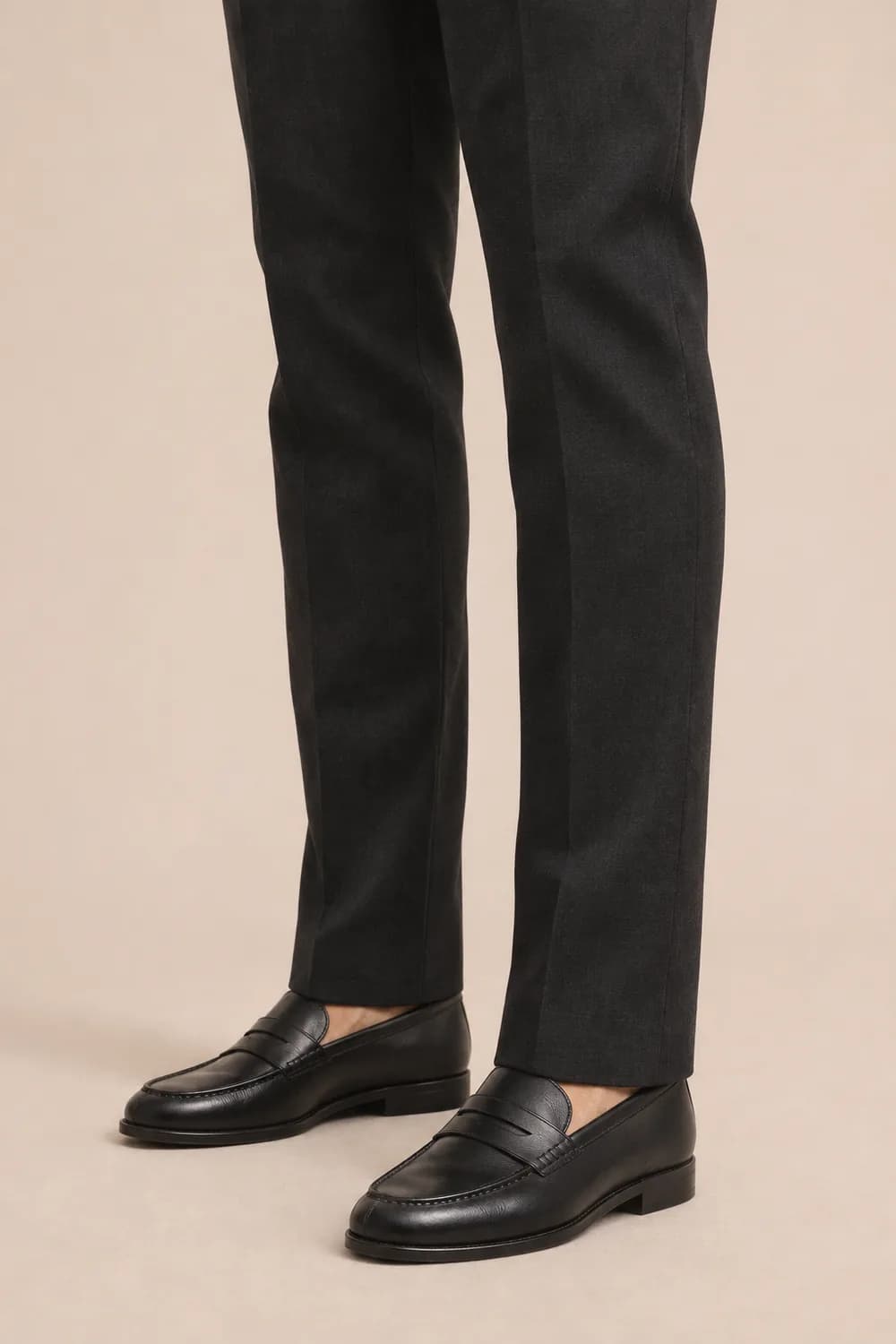
Trousers meant for heels are hemmed with those heels on, and cover most of the heel.
Test: With the heels on, the back hem is 1 to 2 cm (about half an inch) above the floor. In flats, the same pair will drag by roughly the heel height.
Trousers fit when they skim your hips without pulling, the rise sits close without wedging, and the waistband meets the small of your back. Buy for the hips and rise. Leave the waist gap, leg width and hem to a tailor.
The one-minute fitting room test
Wear your usual heel height. Fasten the trousers without a belt.
- Stand and look at the front. The side pockets should lie closed and the zip flat. Pockets that pull open mean the hips are too small.
- Turn and look at the back. Check for pulling across the seat, puckers at the tips of the back darts, and loose folds under the seat.
- Slide a finger into the back waistband. One finger is fine. If you can fit your whole hand, you have a waist gap.
- Sit down. The front should not dig into your stomach and the back should not slide down or open wider.
- Take a long step and lift a knee. The crotch should not pull into you and the fabric should not strain across the thighs.
If they pass steps 1, 2, 4 and 5, they are worth buying, even with a waist gap or a long hem.
Ignore the size label, measure instead
Women's sizes are not standard. The same number can differ by several centimeters between brands, and between styles from one brand. Measure your natural waist and the widest part of your hips with a tape, then compare both to the size chart for that exact style. If your hips and waist fall in different sizes, size for the hips.
Petite ranges, usually for around 160 cm (5 foot 3) and under, shorten the rise and the knee position as well as the inseam. Hemming regular trousers fixes the length but leaves the knee low and the crotch hanging. Tall ranges, usually from around 173 cm (5 foot 8), lengthen the rise too, which no tailor can add later.
What a tailor can and cannot fix
The hips, seat, thighs and rise set the size. Women's trousers rarely have the seam allowance to let them out, and a tailor cannot add rise.
A tailor can close a waist gap by taking in the center back and deepening the back darts, taper the leg, take in a baggy seat and hem to any length. Letting out the waist depends on a center back seam with spare fabric inside, which many women's trousers do not have, so check before you rely on it.
Hem length: flats or heels
Decide which shoes the trousers are for before you hem them. A full-length hem cut for flats sits 1 to 2 cm (about half an inch) off the floor at the back. Put on an 8 cm (3 inch) heel and the back hem lifts well clear of the heel, so the same trousers look short. Hem them for that heel and they will drag on the floor in flats. If you wear both, choose a cropped or ankle length that ends at or just above the ankle bone.
Wide-leg trousers need the most length. With the shoes on, the hem should cover most of the shoe and stop just short of the floor.
Slim, straight and wide in 2026
Slim and cigarette trousers follow the leg to the ankle and are usually ankle length. You should still be able to pinch fabric at the thigh.
Straight trousers drop from the hip in a straight line.
Wide-leg and pleated trousers, often high-rise, hang in a column from the hip. The waist and hips should still fit closely. That is the difference between a relaxed cut and trousers that are too big: in a relaxed cut the extra room starts below the hip, while trousers that are too big gap at the waist, sag at the seat and slide down.
When standard sizing does not fit you
Curvy hips and a smaller waist. You will usually see a waist gap. Look for curvy cuts with more room in the hip and seat, or high-stretch fabric, and plan on taking in the back waist.
Fuller thighs. Straight and wide legs give room without a size jump. If slim cuts fit your thighs, they will be loose at the waist.
Stomach. A high rise with a flat front or soft pleats sits above the stomach. A low rise rolls under it.
Flat seat. Have the seat taken in so the fabric does not sag under it.
Related guides
For a pair you already own, try the fit check with a mirror photo or see if a tailor can fix it.
Can a tailor fix it?
The legs bunch and pool over the shoes.
The inseam is too long for you or for the shoes you wear with them.
What to do: Have them hemmed while you wear the shoes you will wear most with them. Ask for a slight slant so the back is longer than the front.
The waist is loose and needs a belt to stay up.
The waist is too big for you, often because you sized for the hips or thighs.
What to do: Take in the waist at the center back seam. Up to about 5 cm (2 inches) is routine; more starts to distort the back pockets.
The waist is too tight to close comfortably.
The waist is too small. Men's dress trousers usually have 2.5 to 4 cm (1 to 1.5 inches) of spare fabric in the center back seam; many women's trousers have little or none.
What to do: Let out the center back seam if there is allowance inside. Check before you buy by looking inside the back waistband.
The waistband gaps at the back while the hips fit.
Your waist is smaller relative to your hips than the pattern assumes.
What to do: Take in the center back waist and, if needed, deepen the back darts. Next time try a curvy cut.
Loose folds of fabric hang below the seat.
The seat is cut fuller than your body.
What to do: Take in the seat through the center back seam, usually done with the waist.
The legs look wide and flap when you walk.
The leg is cut fuller than you want from the knee down.
What to do: Taper the legs from the knee or mid-thigh to the hem. A taper narrower than the shoe looks wrong, so stop at about 18 cm (7 inches) flat for men.
The hem sits above the shoe and shows sock when you stand.
The inseam is too short, or the trousers were hemmed for a different shoe.
What to do: Let down the hem if there is 3 to 4 cm (1.5 inches) of fabric folded inside. On worn trousers the old hem line can show.
Side pockets pull open and lines fan out from the crotch across the thighs.
The hips, seat or thighs are too small. There is rarely enough seam allowance there to let out.
What to do: Return them. Go up a size and have the waist taken in, or try a cut with more room in the seat and thigh.
Prices are typical ranges at an independent tailor in the US and vary by city. Check another garment →
Asked often.
- Should dress pants have a break?
- Slim and classic cuts look best with no break or a slight break: the front hem just touches the shoe. A full break with several folds reads as too long. Wide-leg trousers hang straight with the hem close to the floor.
- Should dress pants be tight in the thighs?
- No. You should be able to pinch 2 to 4 cm (1 to 1.5 inches) of fabric at mid-thigh, more in a relaxed cut. Lines fanning out from the crotch mean the thigh is too small, and that is hard to fix.
- Where should dress pants sit on the waist?
- Most dress trousers sit at or just below the navel, higher than jeans. A higher rise keeps the shirt tucked and the waistband level when you sit.
- Are pleated dress pants still worn?
- Yes. Pleats add room at the hip and thigh and suit classic and relaxed cuts. They should lie closed when you stand; pleats that spread open mean the trousers are too tight across the hips.
- What should I size for when buying trousers off the rack?
- Size for the seat, hips and thighs, because those cannot be let out much. The waist and length are easy for a tailor to adjust.