How a T-Shirt Should Fit.
How a women's T-shirt should fit: shoulders, bust, neckline, sleeves and length, fitted versus oversized cuts, unisex sizing and shrinking.
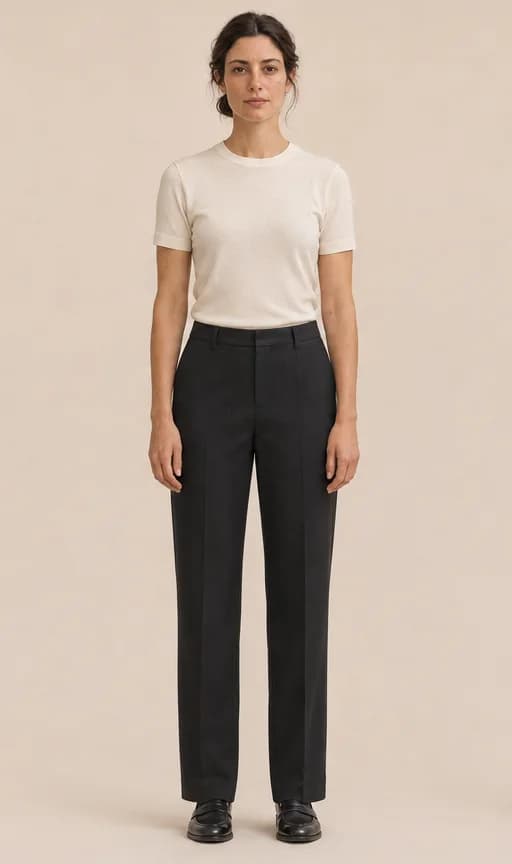
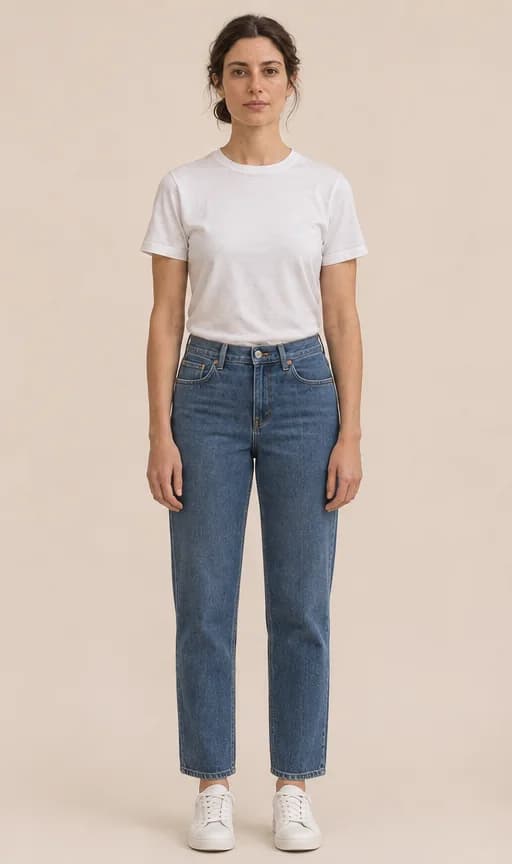
Right size: the shoulder seams sit on the shoulder bones, the body skims the torso without clinging, and the hem covers the waistband.
The fit in 30 seconds.
Check these in order. The first ones are the hardest to alter.
- 01
Shoulders
On a regular tee, the shoulder seam sits on the edge of your shoulder bone.
Test: The seam lands within about 1 cm (3/8 inch) of the bony point of your shoulder. A drop-shoulder cut puts it lower on purpose.
- 02
Bust
The fabric skims your bust without pulling toward the armpits.
Test: No diagonal lines run from the bust to the underarms, and the front hem hangs level with the back hem.
- 03
Neckline
The neckline sits where the style intends and lies flat.
Test: Lean forward about 45 degrees: a crew, scoop or V-neck stays against your chest instead of falling open.
- 04
Sleeves
The sleeve lies close to your arm without squeezing.
Test: One finger fits under the sleeve hem, and the hem leaves no mark on your upper arm.
- 05
Waist and hips
The hem clears your hips without catching or riding up.
Test: Sit down and stand up: the hem falls back into place instead of rolling up above your hips.
- 06
Length
The length matches the cut and the waist of what you wear it with.
Test: A regular tee ends around the hip bone. A cropped tee ends at the waistband of high-rise bottoms. For tucking, at least 10 cm (4 inches) below your waist.
Test it in under a minute
Stand side-on to the mirror first. The front and back hems should hang level. If the front rides higher than the back, the tee is too short or too tight for your bust. Then check the shoulder seams, which on a regular cut sit on the edge of your shoulder bones, and look for diagonal lines running from your bust to your underarms.
Now move. Raise both arms overhead: the hem lifts and should drop back into place when you lower them, without staying rolled up above your hips. Lean forward about 45 degrees and look down. A neckline that falls open at that angle will do the same every time you bend. Sit down: the tee should not cling to your stomach or catch on your hips. Lift and bend one arm. The sleeve should move with it and leave no mark on your skin.
What to get right when you buy
A T-shirt is rarely worth tailoring, so get it right in the store. The bust, shoulders and armholes are fixed. A tailor can shorten the hem and sleeves and take in the sides, but on a basic tee that is often more trouble than it is worth.
Fabric changes how a size fits. Thin jersey clings to the bust and stomach and shows what is underneath. Heavier jersey hangs straighter and keeps its shape. A little stretch lets a fitted tee follow your bust and waist without pulling.
Plan for the wash. Cotton jersey that is not pre-shrunk gets shorter in hot water and in the dryer. If it is only just long enough in the store, it will be too short later. Wash cool and hang it to dry.
Sizes vary between brands, and a unisex tee is a men's cut: wider shoulders, a straight body and more length, with no room shaped for a bust. Compare the chest measurement on the size chart with your bust instead of converting sizes. A unisex tee that fits your shoulders is often tight at the bust and loose at the waist.
Fitted, regular, relaxed and cropped
A fitted tee follows your bust and waist. Right means it skims without stretching into lines, and the sleeves and hem lie flat. Too small means horizontal pulls across the bust and a front hem that rises.
A regular tee falls fairly straight from the bust. Right means a little room at the waist and a hem around your hip bone.
Relaxed, boxy and oversized tees are cut wide on purpose, with a dropped shoulder and wider sleeves. Their length is scaled to the width, so a boxy tee is often short. A regular tee bought two sizes up gets wide and long at once: the shoulder seams slide down your arms, the neckline opens and the hem hangs to mid-thigh. That is too big, not oversized.
A cropped tee ends at or above the waist. It works with high-rise bottoms, where the hem meets the waistband with no gap when you stand.
When standard sizes don't fit you
Larger bust: size for the bust, then check the length. A larger bust takes up length at the front, so look for longer tees or ones with a shaped front. Scoop and V-necks sit flatter than a high crew on a fuller bust. If the waist is then loose, tuck the front or have the sides taken in.
Full hips: a straight tee that fits your bust can catch on your hips and ride up. Choose a slight A-line shape, side slits, or a length that ends above or below the widest part of your hips.
Stomach: heavier jersey and a regular cut hang over a stomach instead of clinging. A slightly longer tee works better than a bigger size, which only adds width at the shoulders.
Petite: regular tees put the shoulder seams down your arms and the hem at your thighs. Petite sizes shorten the body and narrow the shoulders.
Tall: tall sizes add body length. Sizing up adds width, not much length.
Related guides
A tee is most often worn with jeans or under a blazer, so check those next. To check a tee you already own, upload a mirror photo to the fit check, or take the fit quiz.
Can a tailor fix it?
The shoulder seams hang down your arms on a tee that is not cut oversized.
The tee is too wide at the shoulders for you.
What to do: Buy a smaller size or a narrower cut. Shoulder seams on a knit tee are not worth moving.
The fabric stretches across your chest or bust, or the front hem rides up.
The tee is too small for your chest or bust.
What to do: Size up, or look for a tee with more length at the front or a bit of stretch. Fabric cannot be added.
The tee reaches down your thighs.
The body is too long for your torso.
What to do: Have the hem shortened. Ask for a twin-needle or coverstitch hem so it matches the original and still stretches.
The sleeves are long or wide and flap around your arms.
The sleeves are cut for a bigger arm than yours.
What to do: Have the sleeves shortened or narrowed at the underarm seam.
The body is wide and boxy when the shoulders fit.
The cut is wider through the body than you need.
What to do: A tailor can take in the side seams. Many tees are knit as a tube with no side seams, which makes it harder, and on a basic tee it is often not worth it.
The tee got shorter and tighter after a few washes.
Cotton jersey that was not pre-shrunk shrinks in hot water and in the dryer, mostly in length.
What to do: Buy pre-shrunk cotton or a blend, or buy with some length to spare. Wash cool and hang dry from then on.
The neckline has stretched and ripples instead of lying flat.
A weak rib collar that has been pulled over the head and washed hot.
What to do: Replace the tee. Next time look for a thick, firm rib at the neck and pull the tee on by the body, not the collar.
The side seams twist toward the front of your body.
The fabric was cut off-grain, so it twists more with each wash.
What to do: Return it. The twist comes back after any alteration.
Prices are typical ranges at an independent tailor in the US and vary by city. Check another garment →
Asked often.
- Should a T-shirt be tight?
- No. A fitted tee skims your chest and arms, but you can still pinch a little fabric at the sides and the sleeves leave no marks. If the fabric stretches into lines, it is too small.
- How long should a T-shirt be?
- Long enough to cover the waistband when you raise your arms, and short enough to end around the middle of your fly or your hip bone. Cropped and tucked styles are the exceptions.
- How do I tell an oversized tee from one that is too big?
- An oversized tee is cut wider and with a dropped shoulder, but its length and sleeves are scaled to match. A regular tee two sizes up gets longer as well as wider, so the hem falls to your thighs and the neckline opens up.
- Will a cotton T-shirt shrink?
- Cotton that is not pre-shrunk loses some length in the first few hot washes and in the dryer. Check the label, wash cool and hang it to dry.