How to Measure Yourself for Clothes
Where the tape goes for chest or bust, waist, hips, shoulders, sleeve, neck, inseam and rise, how to do it alone, and how to measure a garment laid flat.
By Ilias Ism
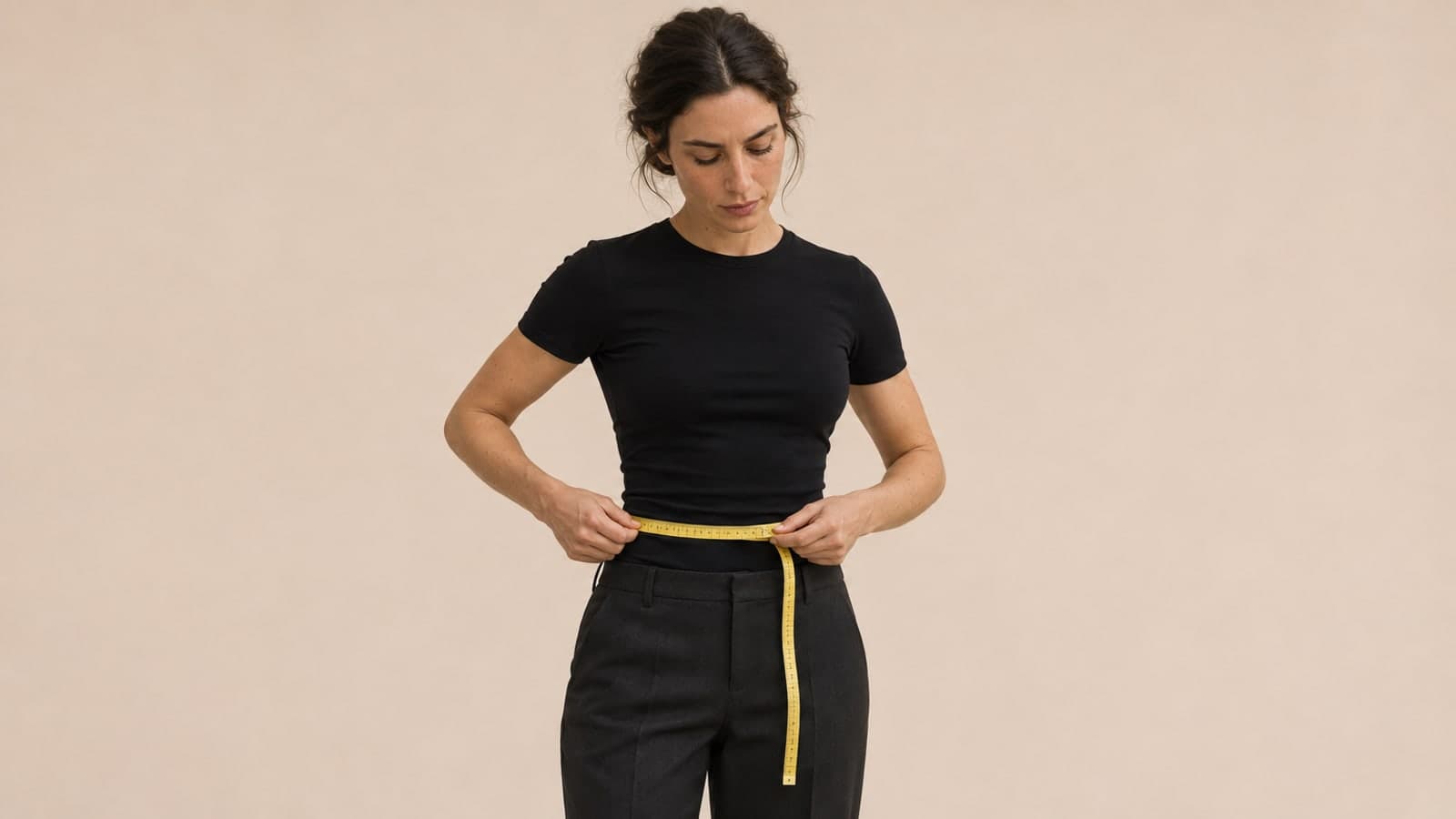
You need a soft tape measure, a mirror and five minutes. Wear underwear or thin, close-fitting clothes, stand straight and relaxed, and breathe normally. Keep the tape level and snug, never tight: one finger should slide under it. Take every measurement twice and write down the larger one if they differ.
If you do not have a soft tape, use a piece of string or a phone charger cable, mark it with your fingers or a pen, and lay it along a rigid ruler or a metal tape measure.
Chest (men) or bust (women)
Where the tape goes. Around the fullest part of the chest or bust, under the armpits and across the shoulder blades. Keep your arms down at your sides once the tape is in place.
Women. Wear the bra you plan to wear with the garment, since a different bra changes the number. Some charts also ask for the underbust, measured snugly around the ribcage directly under the bust.
Common mistakes. The tape slipping down at the back, which you will see in the mirror. Holding your breath or puffing out your chest. Measuring with your arms raised.
Waist
Where the tape goes. For a natural waist, around the narrowest part of your torso, usually just above the belly button. To find it, bend to one side: the crease that forms is your waist.
For trousers and jeans. Also measure where you actually wear the waistband, usually a few centimeters lower. Many men wear trousers well below the natural waist, so the trouser waist can differ from the natural waist by several centimeters.
Common mistakes. Pulling your stomach in. Measuring over a belt or a thick waistband.
Hips
Where the tape goes. Around the fullest part of your hips and seat, with your feet together. Look in the mirror from the side to make sure the tape is level at the back and passes over the fullest part of the seat, which is often lower than people think.
Common mistakes. Standing with your feet apart, which adds to the number. Measuring at the hip bones instead of the widest point.
Shoulders
Where the tape goes. Across the back, from the outer edge of one shoulder bone to the other. Find the bony point at the top of each arm, where a jacket's shoulder seam should end.
Alone. This one is hard to do on yourself. Measure a jacket or shirt that fits well at the shoulders instead, seam to seam across the back. That number is more useful anyway, because it is the one listings give.
Sleeve
Men's dress shirts. Shirt sleeve sizes run from the center of the back of the neck, over the shoulder point and down to the wrist bone, with the arm slightly bent. You need a second person, or a shirt that fits to measure instead.
Jackets and most women's tops. From the shoulder point down the outside of the arm to the wrist bone. For a jacket, stop about 1 to 1.5 cm (half an inch) above where you want the shirt cuff to end.
Common mistakes. Measuring with the arm straight and tense. Mixing up the two methods, which differ by half your shoulder width.
Neck
Where the tape goes. Around the base of the neck, where a shirt collar sits, just below the Adam's apple. Add about 1.3 cm (half an inch) to get your collar size. A fastened collar should let two fingers slide in.
Common mistakes. Measuring high on the neck. Tilting your head down.
Inseam
Where the tape goes. From the crotch down the inside of the leg to where you want the hem, usually the floor or the top of the shoe.
Alone. Stand against a wall in socks, place a hardcover book between your legs with its spine pressed up into the crotch, and mark the wall at the top of the spine. Measure from the mark to the floor. That is your inseam to the floor, barefoot. Trousers worn with shoes usually end a little shorter, so check the number against a pair you own.
Easier. Measure a pair of trousers that you like the length of, from the crotch seam to the hem along the inside leg.
Rise
Where the tape goes. Rise is the distance from the crotch to the waistband. On the body, the full rise runs from the waist at the front, between the legs, to the waist at the back. It is awkward to measure on yourself and few charts use it.
Easier. Measure the front rise of trousers that sit where you like: from the crotch seam straight up to the top of the waistband. As a rough guide for a mid-range size, a men's mid rise is around 25 cm (10 inches) and a high rise 28 cm (11 inches) or more. On women's trousers and jeans, a mid rise is around 21 to 24 cm (8.5 to 9.5 inches) and a high rise 25 cm (10 inches) or more.
Measuring a garment laid flat
Measuring a garment you already like is the most reliable way to choose a size, because the result includes the amount of room you prefer. Lay it flat on a table, close every button and zip, smooth out wrinkles without stretching the fabric, and measure straight across.
- Pit to pit. From armpit seam to armpit seam. Double it for the chest circumference.
- Shoulder. From shoulder seam to shoulder seam across the back.
- Sleeve. From the shoulder seam to the end of the cuff.
- Length. From the highest point of the shoulder, next to the collar, to the hem.
- Waist. Across the top of the waistband. Double it.
- Front rise. From the crotch seam to the top of the waistband.
- Inseam. From the crotch seam to the hem along the inside leg.
- Thigh. Across the leg 2.5 cm (1 inch) below the crotch.
- Leg opening. Straight across the hem.
Compare these with the garment measurement chart in a listing. Within about 1 cm (3/8 inch) is a match, since factory tolerance alone can make that difference.
Using your numbers
Body measurements go against a brand's size chart. Garment measurements go against a garment measurement chart. Do not mix them up: the garment will always be bigger than your body by the amount of ease the cut allows. How to buy clothes online that fit explains how to read both.
Then check how the garment sits once it arrives, with how a dress shirt should fit, how jeans should fit for women, or by uploading a mirror photo to fit check.
How Clothes Are Made: From Fiber to Finished Garment
Every step from fiber to finished garment, and the three places where fit is decided: the pattern block, grading between sizes, and factory tolerance.
How to Measure Inseam (and What It Means)
Three ways to measure your inseam and when to use each, how shoes and break change it, inseam by height from published brand charts, and what inseam means on shorts.
How to Shrink a Shirt, and How Much It Will Really Shrink
Wash it and tumble dry it until it is bone dry. What each fabric can lose in cm and inches, which method to use, why a full size is out of reach, and when a tailor is the better fix.