What a Tailor Can and Cannot Fix (With Typical Costs)
Which alterations are cheap, which are expensive, and which are not worth paying for, garment by garment, with typical USD prices at an independent tailor.
By Ilias Ism
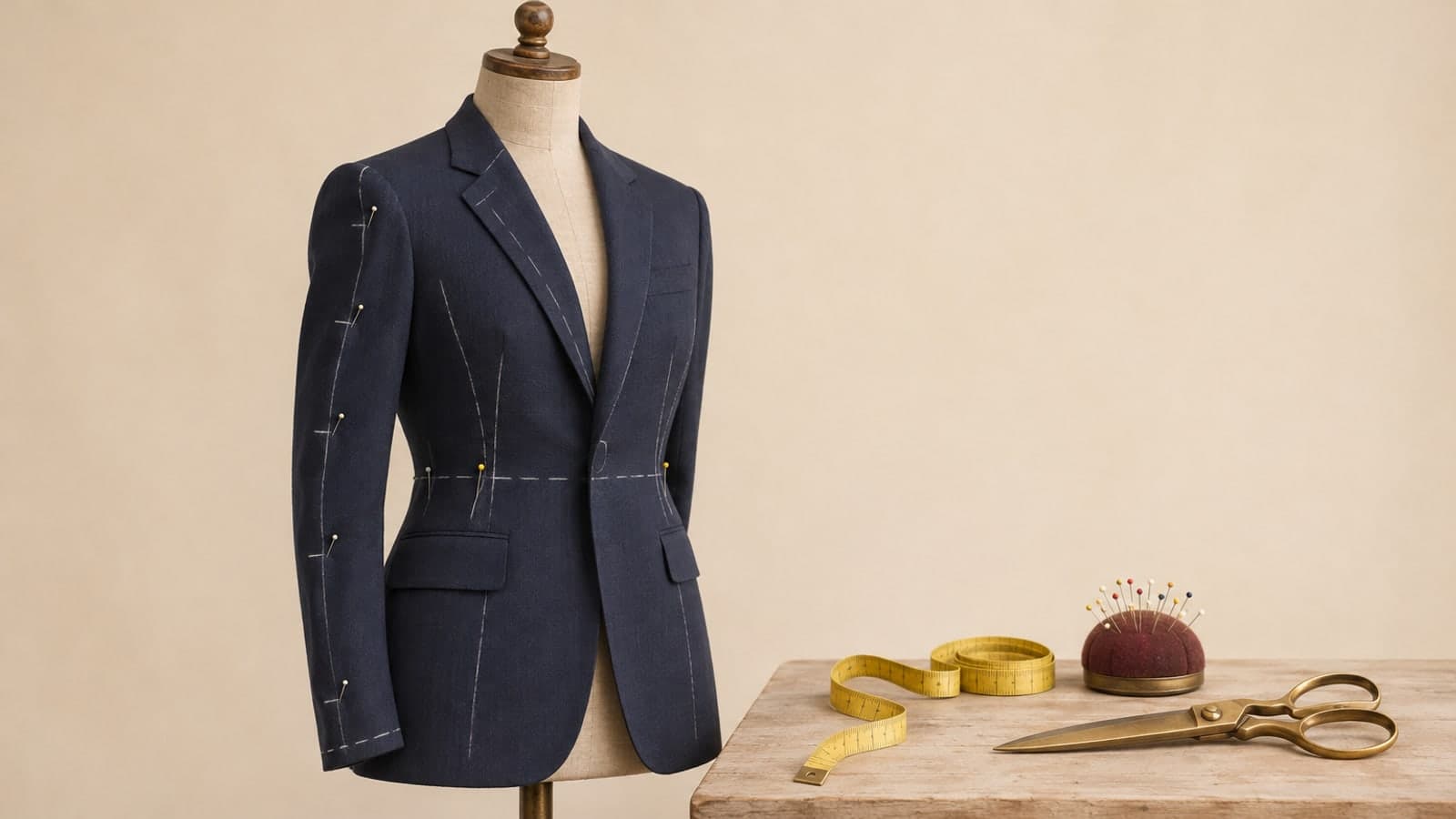
A tailor can make things shorter and narrower. A tailor can rarely make things longer or wider, and almost never fix shoulders. Buy for the shoulders, chest or bust, and seat, then let a tailor handle length and waist.
The prices below are typical ranges at an ordinary independent tailor in the US. Big cities, rush jobs and luxury fabrics cost more; small towns often cost less. Always ask for a price before you leave the garment.
The rule behind every alteration
Every garment has seam allowance, the strip of fabric between the stitching and the cut edge. Taking in uses up some of it, so it almost always works. Letting out needs spare allowance, and most ready-made clothes have 1 to 2 cm (under an inch) or less. Dress trousers and suit jackets are the exception: many have 2 to 4 cm (1 to 1.5 inches) in the center back seam.
Cost follows how many parts have to come apart. A trouser hem touches one seam. A jacket shoulder means removing the sleeve, the lining, the pad and the collar.
Costs by garment
| Garment | Easy | Expensive | Not worth it |
|---|---|---|---|
| Trousers and chinos | Hem $15 to $30; take in waist $20 to $40; taper legs $25 to $45 | Let out waist $20 to $40, if there is allowance; shorten rise $40 to $70 | Lengthen past the hem allowance; rise or seat too small |
| Jeans | Hem with original hem kept $20 to $35; taper $30 to $50 | Take in waist at the back yoke $30 to $50 | Let out waist; fix a short rise |
| Suit jacket or blazer | Shorten sleeves, non-working buttons $25 to $45; take in sides or back $35 to $60 | Shorten sleeves with working buttonholes $60 to $120; adjust collar $40 to $80 | Shoulders, $80 to $200 and often still wrong; shorten jacket length |
| Dress shirt | Take in sides or add back darts $15 to $35; shorten sleeves $20 to $35 | Narrow the shoulders $40 to $80 | Collar too tight; sleeves too short |
| Dress | Hem $20 to $40; shorten straps $15 to $35; take in sides $30 to $75 | Hem a lined, layered or bias skirt $40 to $90; shorten the bodice $60 to $150 | Too small at the bust or hips; shoulders too wide on a sleeved dress |
| Coat | Shorten sleeves $35 to $70; replace buttons $10 to $25 | Shorten length $50 to $120; replace zip $40 to $80 | Shoulders; chest too small |
| T-shirt and knits | Shorten hem $10 to $20 | Take in sides $15 to $30 | Most fixes, since a new T-shirt often costs less |
Trousers and jeans
Hemming is the most common alteration and the cheapest. Wear the shoes you will wear with the trousers and say how much break you want: none, a slight break where the hem just touches the shoe, or a full break. On jeans, ask for the original hem to be kept if you want the factory look; it costs a little more.
Taking in the waist is done at the center back seam on trousers and at the back yoke on jeans. Up to about 4 to 5 cm (1.5 to 2 inches) usually looks right. Beyond that, the back pockets crowd together.
Tapering the leg from the knee down is easy and works well on regular cuts that are too wide at the ankle. What cannot be fixed is a seat that pulls or a rise that is too short, because there is no fabric to add. More on this in how jeans should fit.
Jackets and blazers
Sleeve length and waist suppression are routine. Shorten sleeves so 1 to 1.5 cm (about half an inch) of shirt cuff shows. If the sleeves have working buttonholes, the tailor has to shorten from the shoulder end instead of the cuff, which costs more, so check before you buy.
Shoulders are the classic no. If the shoulder seam sits past your shoulder bone or the jacket collapses into a dent at the top of the sleeve, return it. A tailor can narrow shoulders, but it involves rebuilding the top of the jacket and the result often still looks altered. Shortening the body of a jacket throws off the pockets and buttons. Both are covered in how blazers should fit.
Shirts
A shirt that fits the collar and shoulders but billows at the waist is a quick fix: the tailor takes in the side seams or adds two darts at the back. Sleeves are shortened by removing the cuff, cutting, and reattaching it. A collar that is too tight cannot be let out, and sleeves cannot be lengthened. Buy for neck and shoulders.
Dresses
Hems, straps and side seams are routine. A lining, several layers or bias-cut fabric push the hem price up because each layer is hemmed separately. A waist seam that sits too low can be raised by shortening the bodice, which means opening the waist seam and resetting the zip. Tightness at the bust or hips is a return. See how a dress should fit.
What to say to the tailor
- Wear what you will wear with it: the shoes for trousers, a shirt under a jacket, the bra you will wear under a dress.
- Stand naturally. Do not pull your stomach in or lift your shoulders while being pinned.
- Say what bothers you, not how to fix it: "it pulls here", "the sleeves cover my cuff", "I want a slight break".
- Ask the tailor to pin it, then look in the mirror, sit down and move before you agree.
- Ask the price, the date, and whether the change can be undone.
- Take in a little less than you think. A second small adjustment is easy; adding fabric back is not.
Before you buy
If something almost fits, use the can a tailor fix it tool before you pay for the garment or the alteration. Anything in the last column of the table is a reason to try the next size or a different cut.
How Clothes Are Made: From Fiber to Finished Garment
Every step from fiber to finished garment, and the three places where fit is decided: the pattern block, grading between sizes, and factory tolerance.
How to Measure Inseam (and What It Means)
Three ways to measure your inseam and when to use each, how shoes and break change it, inseam by height from published brand charts, and what inseam means on shorts.
How to Shrink a Shirt, and How Much It Will Really Shrink
Wash it and tumble dry it until it is bone dry. What each fabric can lose in cm and inches, which method to use, why a full size is out of reach, and when a tailor is the better fix.