How to Shrink a Shirt, and How Much It Will Really Shrink
Wash it and tumble dry it until it is bone dry. What each fabric can lose in cm and inches, which method to use, why a full size is out of reach, and when a tailor is the better fix.
By Ilias Ism
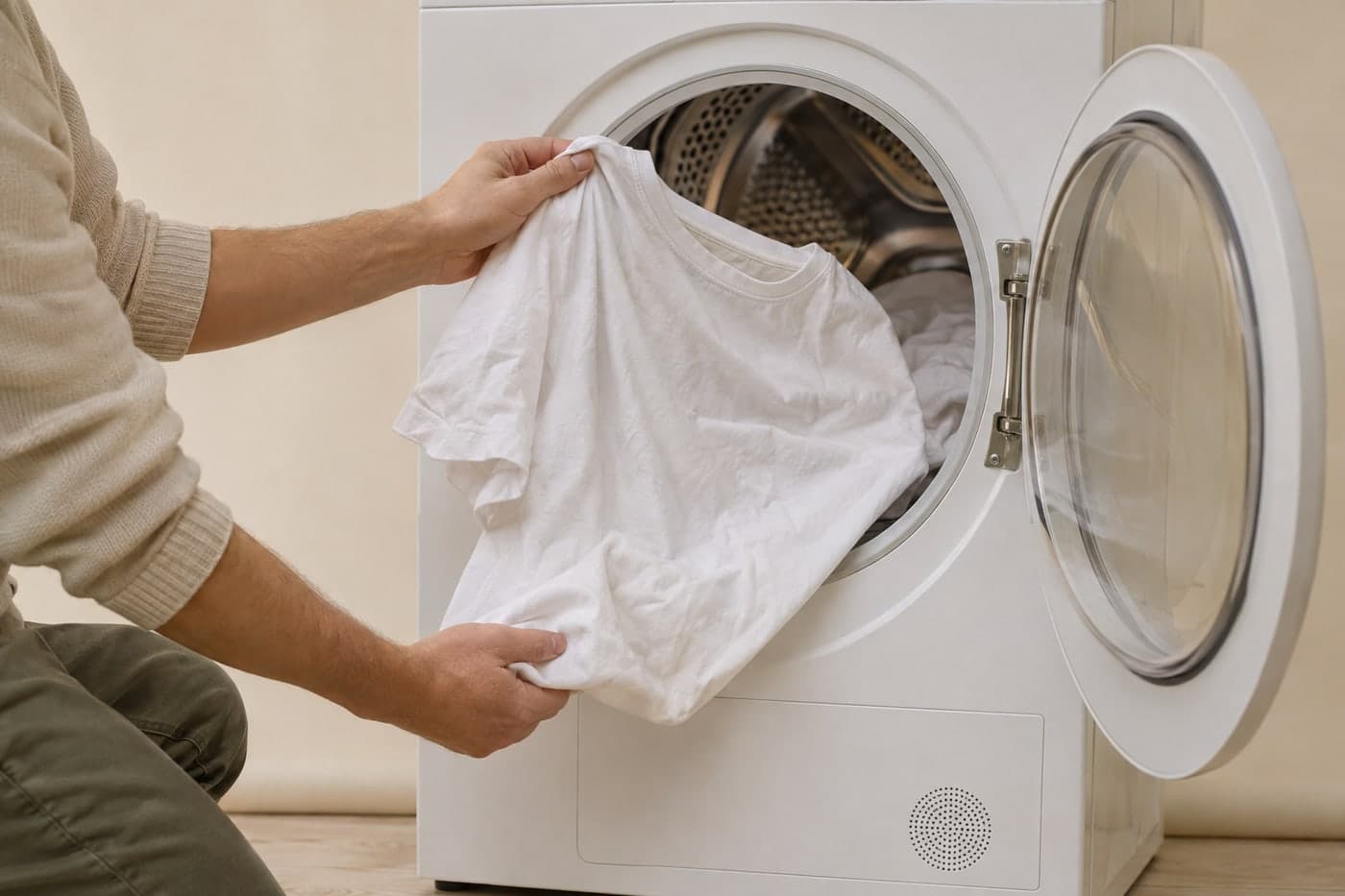
To shrink a cotton shirt, wash it and tumble dry it until it is completely dry. Dryness does the work more than heat does. Expect a pre-shrunk cotton t-shirt to lose about 2 to 5%, mostly in length: on a 76 cm (30 in) shirt that is 1.5 to 4 cm (0.6 to 1.5 in) shorter, but only 1 to 3 cm (0.4 to 1.1 in) narrower across the chest. That is less than one size. Polyester will barely move.
Check the label first
In the US, every garment has to list its fibres by percentage of weight, and garments with a neck carry a label at the inside center of the neck (FTC textile rules). The care label must also say how to wash and dry it and warn against anything that would harm it (FTC care labeling rule). Read both before you start.
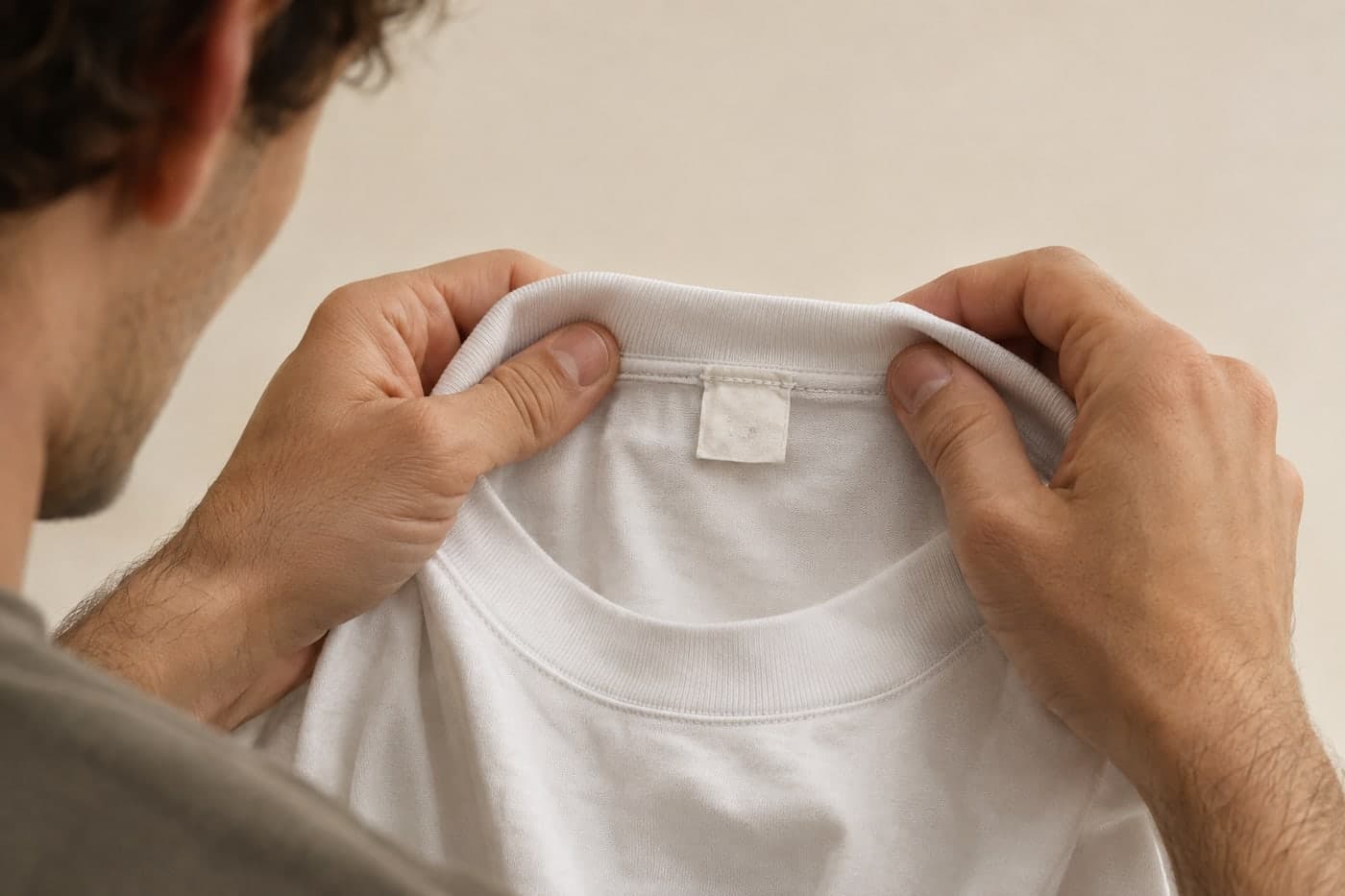
- Mostly cotton or linen: it can shrink. Go on.
- "Pre-shrunk" or "sanforized": it will shrink, but only a little.
- Polyester, nylon, or more than a few percent elastane or spandex: it will not shrink usefully, and heat can damage it.
- Wool, unless it says machine washable: do not try. It felts.
- Rayon or viscose: it can shrink a lot and unevenly. Many women's blouses and dresses are made of it.
- "Do not tumble dry" or "dry flat": the maker is telling you it will shrink or distort in a dryer. That is what you want, but you lose the right to return it.
How much each fabric can shrink
These are the published ranges for a hot wash and a tumble dry. No source tests every shirt, and the same fibre can behave differently depending on how the fabric was knitted or woven and finished.
| Fabric | Typical shrinkage | Source |
|---|---|---|
| Cotton, not pre-shrunk | 4.5 to 9% in length, 3.5 to 8% in width in Cotton Incorporated's knit examples | Cotton Incorporated |
| Pre-shrunk cotton t-shirt | 3 to 5% hot, about 1% washed cold | Custom Ink |
| Woven cotton dress shirt | 1 to 3%, about 2% on average | Proper Cloth |
| 50/50 cotton-polyester | 2 to 3% hot, under 1% cold | Custom Ink |
| Polyester | 0 to 0.5% | Custom Ink, Textile School |
| Linen | 4 to 10% raw, 1 to 3% pre-washed | Nimble Made |
| Rayon or viscose | up to 10% untreated, about 3% with a shrink-resist finish | Ohio State University Extension |
| Wool | felts; no fixed number, and it cannot be undone | Woolmark |
Polyester barely shrinks because it is heat-set at 190 to 220 °C when the fabric is finished, far hotter than any dryer. In a cotton-polyester blend, only the cotton shrinks.
What that means on a real shirt
Measure before you start, so you know what changed. Lay the shirt flat, smooth it without stretching, and measure straight across the chest just below the armholes, then the length from the highest point of the shoulder to the hem.
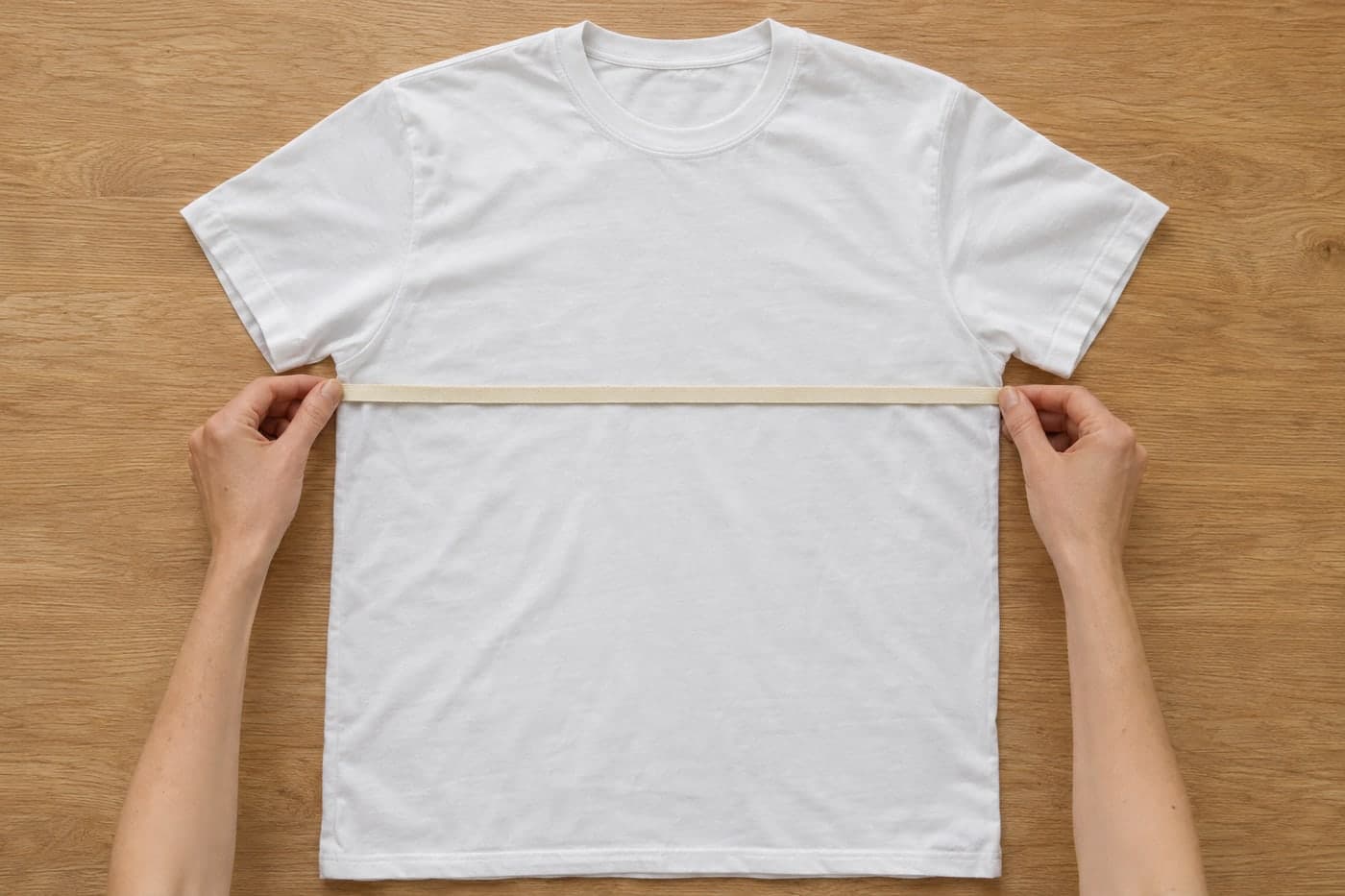
Take a size large t-shirt that measures 76 cm (30 in) long and 56 cm (22 in) across the chest laid flat. That is exactly the large on a widely sold basic tee's spec sheet, where the medium is 2.5 cm (1 in) shorter and 5 cm (2 in) narrower.
| Shirt | Length lost | Chest lost, laid flat |
|---|---|---|
| Polyester, 0.5% | under 0.5 cm (0.2 in) | under 0.5 cm (0.2 in) |
| 50/50 blend, 2 to 3% | 1.5 to 2.3 cm (0.6 to 0.9 in) | 1.1 to 1.7 cm (0.4 to 0.7 in) |
| Pre-shrunk cotton, 3% length and 2% width | 2.3 cm (0.9 in) | 1.1 cm (0.4 in) |
| Pre-shrunk cotton, 5% worst case | 3.8 cm (1.5 in) | 2.8 cm (1.1 in) |
| Cotton not pre-shrunk, 7.3% by 3.5% | 5.5 cm (2.2 in) | 2 cm (0.8 in) |
| One size down, for comparison | 2.5 cm (1 in) | 5 cm (2 in) |
The 3% by 2% row is what Custom Ink reports for a heavyweight pre-shrunk tee after repeated hot washes. The last cotton row is a single jersey from Cotton Incorporated's bulletin.
It shrinks more in length than in width
Proper Cloth says dress shirts shrink more in length than width, with most of it in the sleeve length, the body length and the collar. At 2%, a 89 cm (35 in) sleeve loses about 1.8 cm (0.7 in) and a 38 cm (15 in) collar about 0.8 cm (0.3 in). Knits do the same for a reason Cotton Incorporated explains: dyeing and finishing usually stretch the fabric lengthwise and narrow it, and washing lets it spring back. Some of its knit examples shrank as much in width, so treat this as the usual case, not a rule.
In practice, a shirt reaches the next size's length well before it reaches the next size's width. A screen printer comparing a new extra-large cotton tee with the same model after many machine washes and dries measured about 4 cm (1.5 in) off the length, about 2.5 cm (1 in) off the width, and a visibly tighter collar (Big Brandoh).
The methods, from gentlest to strongest
Cotton Incorporated found that most shrinkage happens late in tumble drying, once the fabric drops below about 20% moisture. In its tests, drying at 38, 66 and 94 °C (100, 150 and 200 °F) gave identical shrinkage, and one wash-and-dry cycle can remove about 90% of what the fabric has to give. A P&G laundry scientist told Martha Stewart the same: the level of dryness matters, not the heat setting.
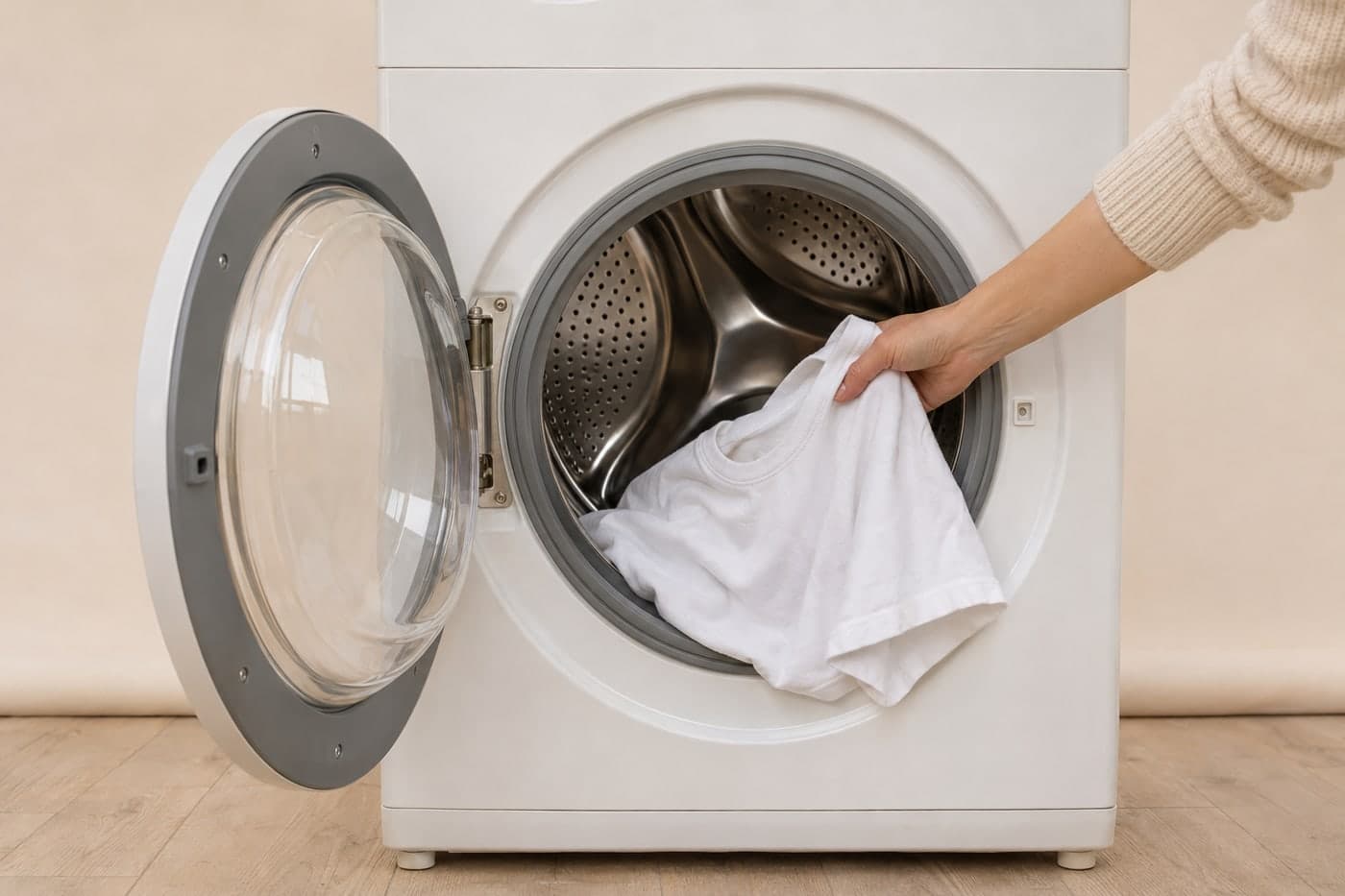
- Wash, then dry flat. You get only the small relaxation shrinkage. Use this to shrink as little as possible.
- Wash, then tumble dry until bone dry. This is the method. Use a long timed cycle, since sensor cycles stop before the fabric is fully dry. Risk: low.
- Hot wash, long hot dry, repeated two or three times. This collects the last 10% or so. Risk: fading, pilling, fuzz and cracked prints, and Proper Cloth calls high-heat shrinkage "much more significant and unpredictable".
- Boil it, then tumble dry. Most guides list this as the strongest. The drying data says extra heat adds little to cotton, while boiling adds the most risk: dye runs, prints peel, and elastane goes brittle. Skip it.
Whichever you pick, turn printed shirts inside out, try the shirt on while it is still warm, and measure after each cycle. Stop as soon as it is right.
Without a dryer
Line or flat drying gives mostly the small relaxation shrinkage, according to Cotton Incorporated, because the tumbling is what pulls the fabric in as it dries. Take it to a laundromat dryer. Ironing a damp shirt until it is fully dry shrinks it a little and unevenly.
Fabric by method
| Fabric | Dry flat | Tumble dry until dry | Hot wash and hot dry | Boil |
|---|---|---|---|---|
| Cotton, not pre-shrunk | a little | most of it | the rest | no gain, more damage |
| Pre-shrunk cotton | very little | most of its 3 to 5% | the rest, up to about 5% | no gain, more damage |
| Cotton dress shirt | very little | most of its 1 to 3% | slightly more, uneven | no |
| Cotton-polyester blend | very little | most of its 2 to 3% | 2 to 3% | no |
| Polyester or nylon | none | none | none, risk of puckering | no |
| Linen | a little | 4 to 6% raw | 7 to 10% raw | no |
| Wool | do not | do not | felts | no |
| Rayon or viscose | a little | risky | uneven, can be 10% | no |
| Anything with elastane | none | small | loses stretch | no |
Why you cannot shrink a shirt a full size
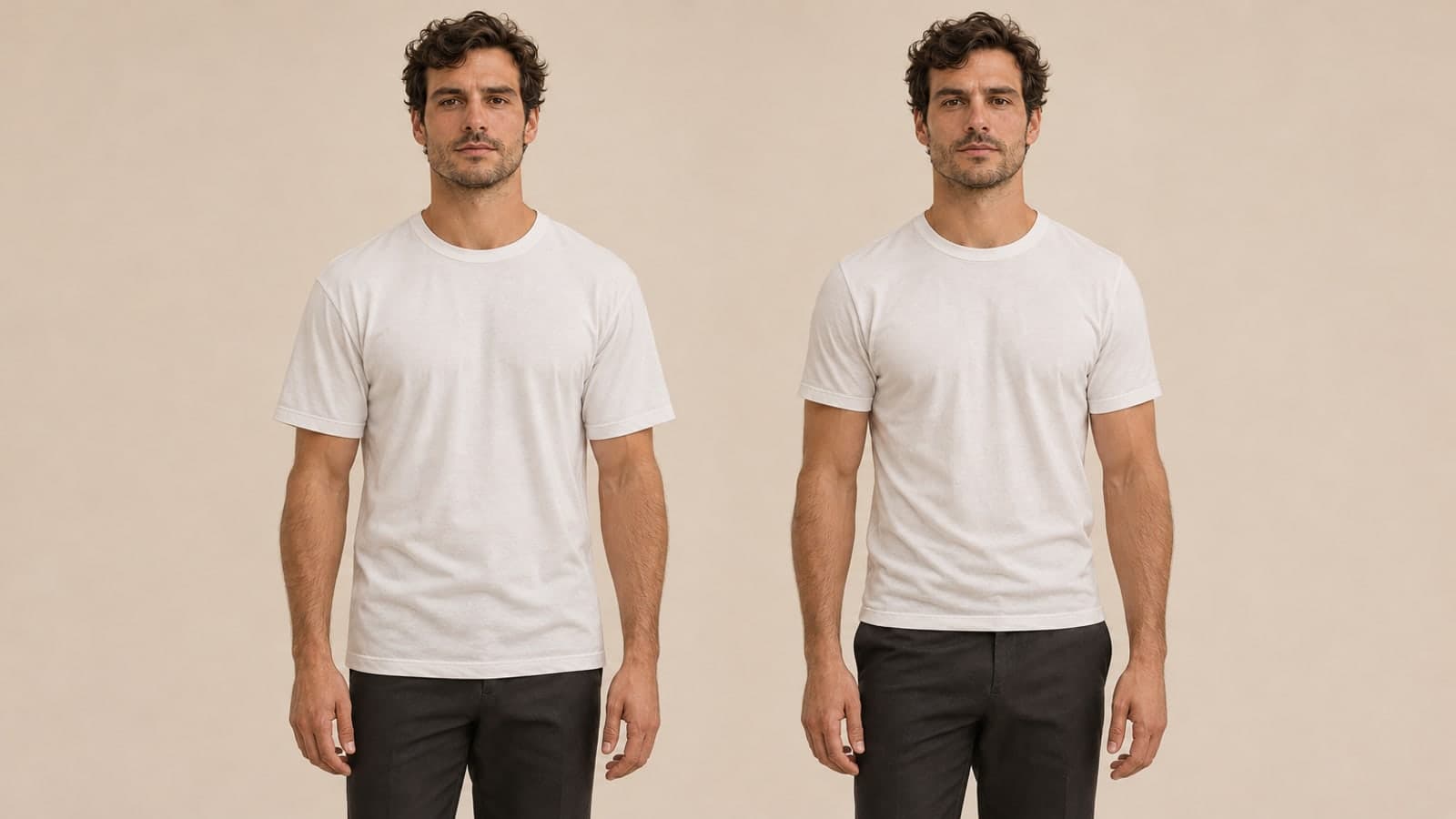
To go from large to medium, the example tee has to lose about 9% of its width and 3% of its length. A pre-shrunk cotton shirt has only 2 to 5% to give, and mostly in length. Long before it is a size narrower, it is too short, the sleeves have crept up and the collar has tightened. The shoulders shrink by the same small percentage, so a shoulder seam that hangs past your shoulder bone will still hang past it.
Untreated cotton has more to give, but you cannot choose where it goes. The maker's spec sheet even allows 2.5 cm (1 in) of tolerance either way on each measurement, so two shirts of the same size can already differ by more than you can shrink one.
Shrinking works for a shirt that is a little long and a little loose. For anything more, use a tailor or exchange it.
A tailor, or an exchange
A tailor can take in the side seams, narrow and shorten the sleeves, and shorten the hem. On a t-shirt it is one seam down each side from the sleeve to the hem, sewn with a stretch stitch so it does not pop (Pindrop Shop). A woven shirt can also take two darts at the back, and a women's shirt can have its existing darts deepened. Typical prices at an independent tailor in the US:
- Dress shirt: sides taken in or back darts $20 to $45, sleeves shortened $20 to $40, hem $15 to $35.
- T-shirt: sleeves narrowed or shortened $15 to $35, hem $15 to $30, sides $20 to $45. Many basic tees are knitted as a tube with no side seams, which makes the sides harder.
A tailor cannot add length, and narrowing the shoulders costs $40 to $80 and often still looks altered. Exchange the shirt instead if the shoulder seam sits well past your shoulder bone, if it is more than one size too big, if the alteration costs more than the shirt, or if you are still inside the return window. Check the price for your problem with the can a tailor fix it tool, and see what a tailor can fix for the full list. How a shirt should sit once it is right is in the guides for t-shirts and dress shirts.
How to stop it shrinking once it fits
- Wash cold or warm.
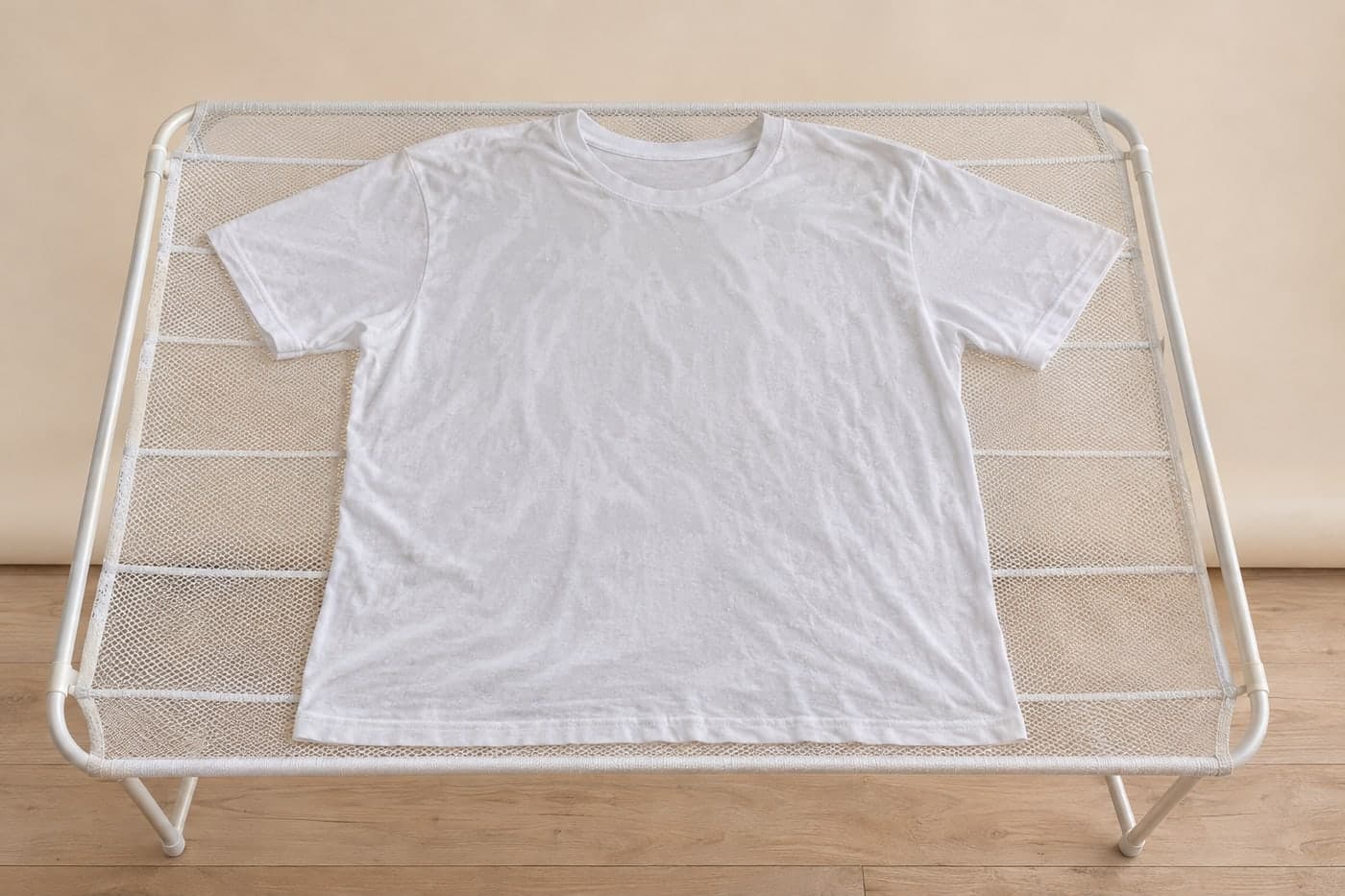
- Dry flat or on a line, or tumble dry on low and take it out while it is still slightly damp.
- Do not over-dry. That is where the shrinkage happens.
- Hang knits only when they are nearly dry, since the weight of the water stretches them.
If you went too far, soak a cotton knit for 15 minutes in room-temperature water with a little fabric softener or hair conditioner, rinse, press out the water, stretch it gently to size on a flat surface and let it air-dry. This does not undo felted wool.
FAQ
Does cotton shrink every time you wash it? Most of it goes in the first wash and dry, and the rest over the next few cycles. After that, a shirt keeps shrinking only slightly, and only if you keep drying it hot and fully dry.
Can you shrink a polyester shirt? Not in a useful way. It is heat-set far above dryer temperatures, so it stays within about 0.5% of its size, and enough heat to change it will pucker or melt it first.
Does hot water or the dryer shrink clothes? The dryer, mostly. Water swells the fibres and the tumbling pulls them in as they dry below about 20% moisture.
Will a pre-shrunk shirt still shrink? Yes, by about 2 to 5%. Pre-shrunk usually means the fabric was compacted by machine at the mill, which takes out most of the shrinkage but not all of it (ShirtSpace).
How Clothes Are Made: From Fiber to Finished Garment
Every step from fiber to finished garment, and the three places where fit is decided: the pattern block, grading between sizes, and factory tolerance.
How to Measure Inseam (and What It Means)
Three ways to measure your inseam and when to use each, how shoes and break change it, inseam by height from published brand charts, and what inseam means on shorts.
Slim vs Regular vs Relaxed Fit: What the Labels Mean
What slim, regular and relaxed cuts change in a shirt or a pair of trousers, in centimeters and inches, who each one suits, and how to tell relaxed from too big.