Slim vs Regular vs Relaxed Fit: What the Labels Mean
What slim, regular and relaxed cuts change in a shirt or a pair of trousers, in centimeters and inches, who each one suits, and how to tell relaxed from too big.
By Ilias Ism
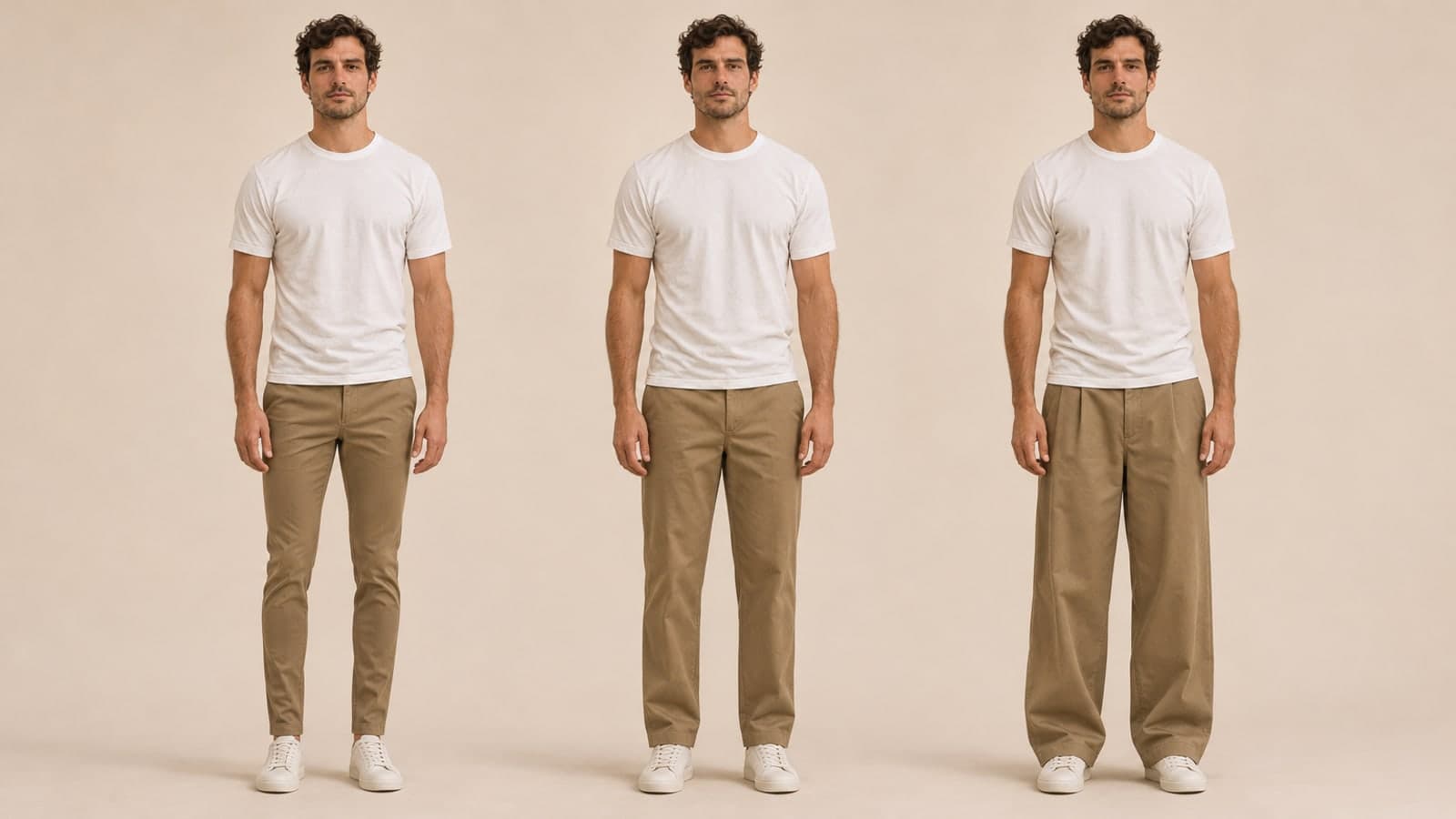
Slim, regular and relaxed are three amounts of room, called ease, added to the same size. The size is set by your body. The cut decides how much space the garment leaves around it. None of the three is the correct one: each is right when the shoulders, waist, rise and length still sit where they should.
What ease is
Ease is the difference between the garment and the body it is made for. If your chest measures 100 cm (39.5 inches) and a shirt measures 112 cm (44 inches) around the chest, the shirt has 12 cm (about 4.5 inches) of ease. Some ease is needed just to move and breathe. Anything beyond that is style.
A cut label changes ease in some places and leaves others alone. A slim shirt and a relaxed shirt of the same size usually have similar collar and sleeve lengths. What changes is the width through the chest, the waist, the armhole and the sleeve. On trousers, the waistband is the same in every cut. What changes is the seat, the thigh and the leg opening.
The numbers
These are typical ranges, not a standard. Every brand sets its own, and the same label can differ by a size between brands. Trouser numbers are for a men's size 32 waist; women's cuts follow the same pattern with narrower openings.
| Where | Slim | Regular | Relaxed |
|---|---|---|---|
| Shirt chest ease | about 8 to 12 cm (3 to 5 in) | about 14 to 20 cm (5.5 to 8 in) | about 22 cm (9 in) or more |
| Shirt waist | tapered, 5 to 10 cm (2 to 4 in) less than the chest | straight or lightly tapered | straight |
| Armhole and sleeve | high and narrow | medium | lower and wider |
| Trouser thigh ease | about 2 to 4 cm (1 to 1.5 in) | about 5 to 8 cm (2 to 3 in) | about 9 to 14 cm (3.5 to 5.5 in) |
| Leg opening, measured flat | about 16 to 17 cm (6.25 to 6.75 in) | about 18 to 20 cm (7 to 8 in) | about 20 to 23 cm (8 to 9 in) |
| Rise | low to mid | mid | mid to high |
T-shirts and knits need less ease than wovens because the fabric stretches. A slim T-shirt can have as little as 4 to 6 cm (1.5 to 2.5 inches) of chest ease and still be comfortable.
Slim
A slim cut follows the body closely. On a shirt, the sides taper from chest to waist and the armhole sits high, which gives you more arm movement than a low armhole does, as long as the chest is not tight. On trousers, the thigh is close and the leg narrows to the ankle.
Slim suits lean and narrow builds, people who wear shirts tucked in or under a jacket, and anyone who wants a clean line with little fabric to manage. It does not suit a larger stomach, chest or thighs: a slim shirt that fits your shoulders but pulls at the buttons is too small, not slim. Watch for X-shaped creases around the buttons, a waistband that cuts in when you sit, and pockets that flare open on trousers.
Regular
Regular, also called classic or straight, has enough room to move without showing much extra fabric. The shirt hangs straight or tapers only slightly. Trousers are roomy through the thigh and fall straight from the knee.
Regular suits most bodies, and it is the cut to try first when slim pulls and relaxed swims. It is also the most forgiving one to alter, because there is enough fabric for a tailor to taper it.
Relaxed
Relaxed adds volume on purpose. Shirts and knits often have dropped shoulders, wider sleeves and more length. Trousers have more room in the seat and thigh, a wider leg and often a higher rise.
Relaxed suits broad or muscular builds, larger stomachs and big thighs, and anyone who wants comfort or a looser silhouette. Pair relaxed with relaxed carefully: a relaxed top over relaxed trousers can hide your shape completely, which can be the point or a problem.
Athletic builds often need a mix. Some brands sell an "athletic" or "tapered" cut: roomy through the seat and thigh like relaxed, narrowing to the ankle like slim. It is the cut most people with big thighs and a smaller waist are looking for.
Relaxed or simply too big
A relaxed garment is drafted with extra room. A garment that is too big is a smaller-sized pattern blown up. The difference shows in the places the cut does not change.
- Neckline and collar. On a relaxed shirt, the collar still sits against your neck. On one that is too big, it stands away from it.
- Shoulders. A relaxed cut may drop the shoulder seam on purpose, but the shirt does not slide around on you. If the seam moves when you shrug, the size is wrong.
- Sleeve and leg length. A relaxed shirt's cuff still ends near the wrist bone. Relaxed trousers end at the ankle or with a little break. Too big means everything is also too long.
- Waist. Relaxed trousers fit at the waist without a belt holding them up. If you need a belt to stop them sliding, they are too big.
- Rise. A relaxed rise sits at the waist it was designed for. Too big puts the crotch low and leaves fabric hanging between your legs.
The rule: a relaxed cut is loose in width. A garment that is too big is also wrong in length and at the waist and neck.
Why the same label differs between brands
There is no shared standard for any of these words. Each brand builds its cuts on its own base pattern, fitted on its own fit model, and names them for marketing as much as for measurement. One brand's slim can be another's regular. Some brands also run several cuts with names like skinny, tapered, straight, loose and baggy, which shifts what slim and relaxed mean within that range.
Labels also drift over time. As looser shapes have come back, some brands have widened their regular cut, so a regular from ten years ago can be narrower than one bought today.
Ignore the word and read the numbers. Measure a shirt or pair of trousers you like, laid flat, and compare the chest width, thigh and leg opening with the listing. How to buy clothes online that fit shows which measurements to take, and how to measure yourself covers the body side.
Which to pick
Fit the parts that cannot be altered first: shoulders on a shirt or jacket, seat and rise on trousers. Then choose the amount of room you like. If the shoulders fit in a regular but the waist is loose, a tailor can taper it to something close to slim. The reverse is rarely possible.
For the checks cut by cut, see how jeans should fit for men and for women. If you are unsure whether a loose piece can be saved, check what a tailor can fix.
How Clothes Are Made: From Fiber to Finished Garment
Every step from fiber to finished garment, and the three places where fit is decided: the pattern block, grading between sizes, and factory tolerance.
How to Measure Inseam (and What It Means)
Three ways to measure your inseam and when to use each, how shoes and break change it, inseam by height from published brand charts, and what inseam means on shorts.
How to Shrink a Shirt, and How Much It Will Really Shrink
Wash it and tumble dry it until it is bone dry. What each fabric can lose in cm and inches, which method to use, why a full size is out of reach, and when a tailor is the better fix.