How to Measure Sleeve Length for Shirts and Jackets
The two different measurements called sleeve length, which garments use which, how to measure alone with a shirt that fits, sleeve length by size from four brand charts, and where every sleeve should end.
By Ilias Ism
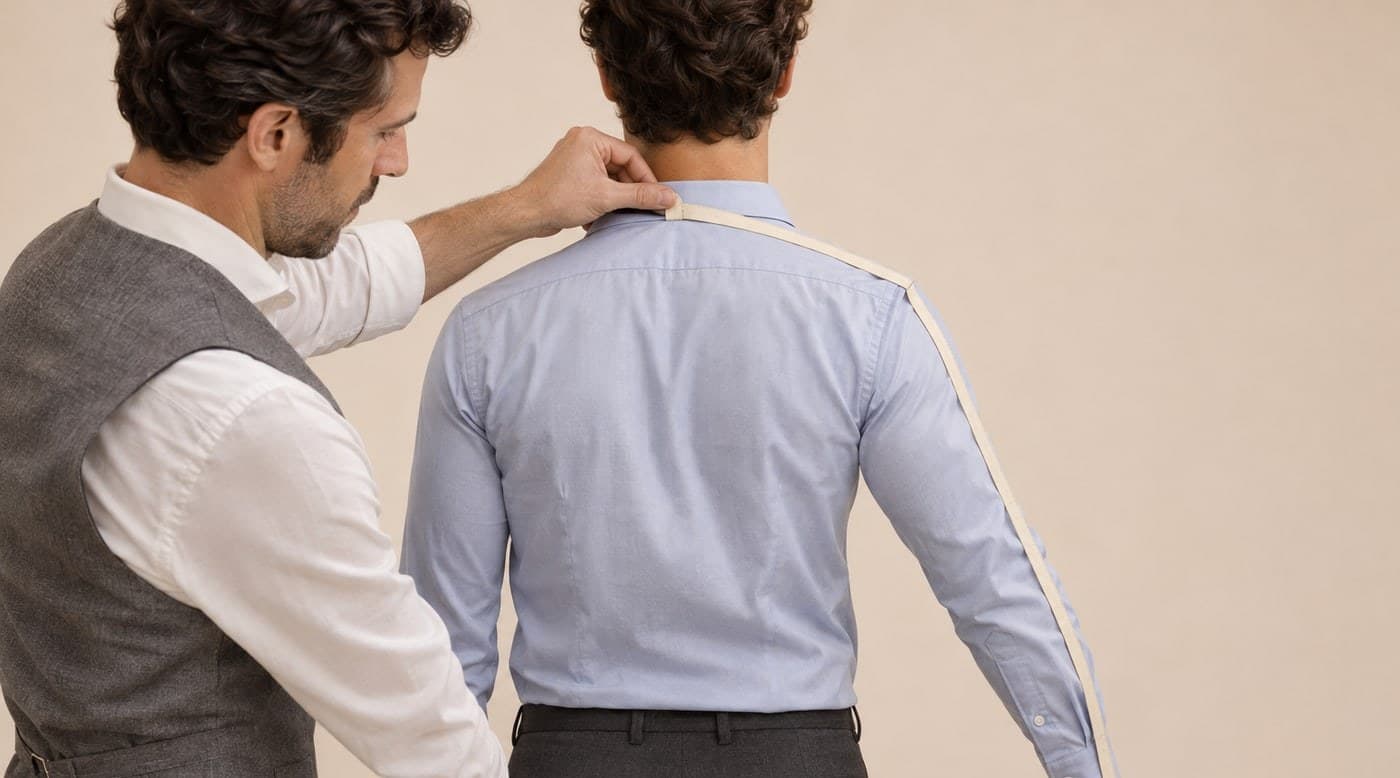
For a men's dress shirt, measure from the center of the back of your neck, across the shoulder and down your slightly bent arm to the wrist bone, then round up to the next inch: that is the second number on the label, as in 15/34. For jackets, coats and many casual and European shirts, measure from the shoulder point down to the wrist instead, which gives a number shorter by about half your shoulder width.
Both are called sleeve length. Knowing which one a chart means is most of the job.
The two sleeve measurements
| Center back method | Shoulder method | |
|---|---|---|
| Starts at | The center of the back of the neck, at the bone you feel at its base | The shoulder point, where a shoulder seam should sit |
| Ends at | The wrist bone, or wherever the cuff should end | The same |
| Used for | US dress shirt sizes (15/33, 16/35), most US letter-size shirt charts | Suit jackets, blazers, coats, many European shirt charts, many garment measurements in listings |
| Typical men's range | 81 to 94 cm (32 to 37 in) | about 58 to 72 cm (23 to 28 in) on shirts (hemdenbox) |
European charts are not consistent either. Olymp measures its shirts from the top of the shoulder seam to the edge of the cuff: 64 cm for a standard sleeve, 69 cm for extra long. Stenstroms measures "from the middle of the neck, along the top of the sleeve" for shirts, knitwear and even blazers. UNTUCKit warns that dress shirt sleeve lengths do not translate to its casual shirt sizes.
The decision rule: if the chart has a diagram, follow the line on it. If it does not, a men's sleeve number above about 76 cm (30 inches) starts at the neck, and one below it starts at the shoulder.
How to measure sleeve length for a dress shirt
You need a soft tape and a second person.
- Stand straight with your arm hanging and the elbow slightly bent. Some charts ask you to rest your hand on your hip instead; follow the chart.
- Your helper places the end of the tape on the center of the back of your neck, on the bone that sticks out when you bow your head.
- They run it across the top of your shoulder to the shoulder point and hold it there.
- They continue down the outside of your arm, over the elbow, to just past the wrist bone, where the hand starts to widen.
- Read the number, measure the other arm too, and use the longer one. Round up to the next whole inch.
Bend the arm: a sleeve measured on a straight, tense arm comes out short and rides up as soon as you reach forward. Do not subtract anything for shrinkage either. Cotton shirts shrink over time, by 3 to 4 percent or about 1 to 1.5 cm in the sleeve according to Justin Kwan in his video How to Get Sleeve Length Right, and Proper Cloth adds 0.3 inch to its sleeves to allow for it.
Common mistakes. Starting the tape at the side of the neck or the collar point instead of the center. Holding the arm straight. Measuring over a sweater or a jacket.
How to measure sleeve length for a jacket or coat
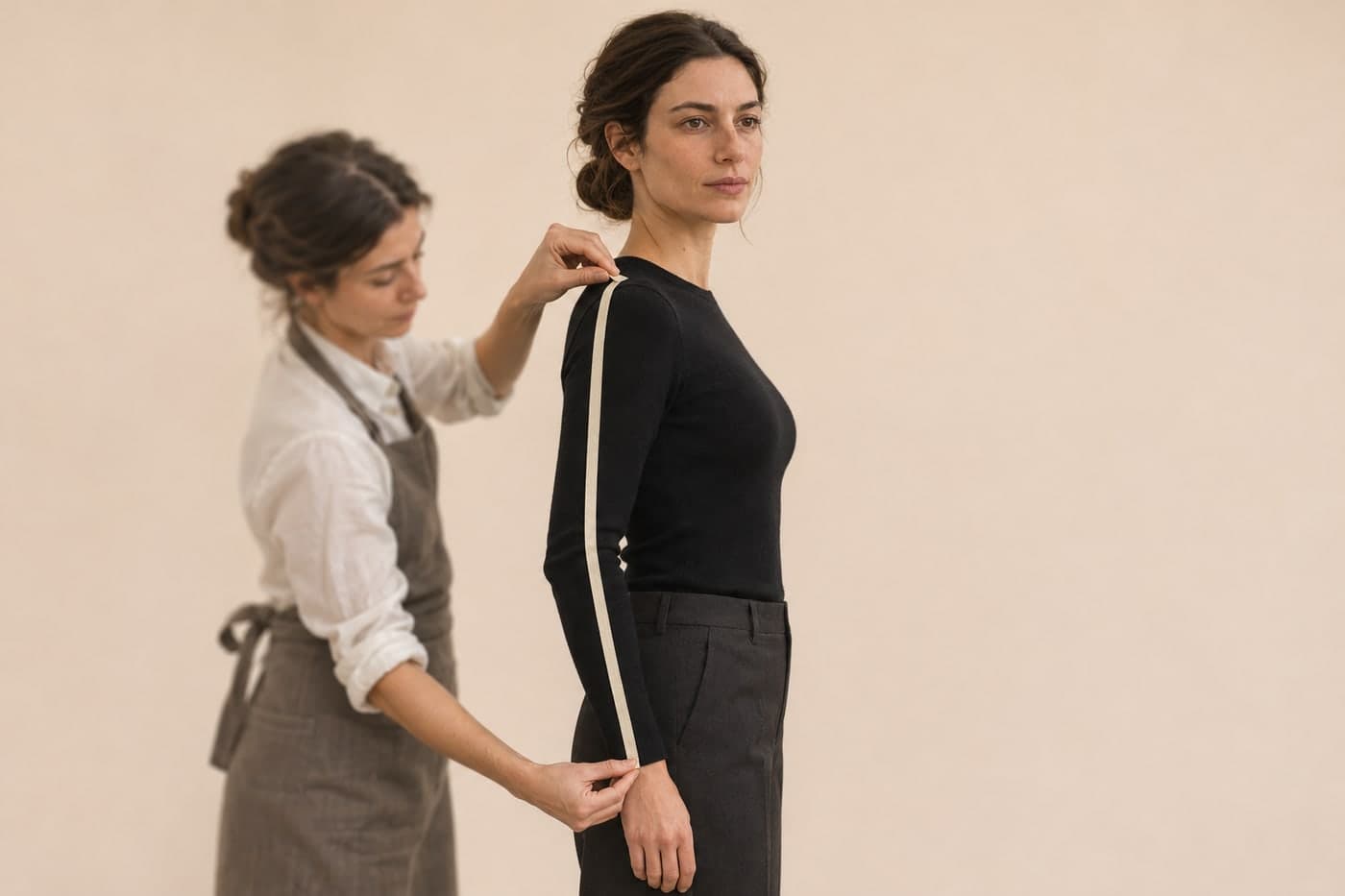
Start at the shoulder point, the bony outer edge where a jacket's shoulder seam should end. Run the tape down the outside of the slightly bent arm to the wrist bone. That is your arm length, and it is the number jacket and coat charts mean by sleeve.
For a suit jacket or blazer, stop at the wrist bone, or 1 to 1.5 cm (about half an inch) shorter than where your shirt cuff ends, so a little cuff shows. For an overcoat, measure to the base of the thumb, since the coat has to cover both cuffs. Measure wearing the shirt you plan to wear with the jacket, and with a sweater for a winter coat.
How to measure sleeve length alone
You cannot measure the center back method on yourself with any accuracy. Measure a shirt that fits you instead. It is also the more reliable number, because it already includes the length you like.
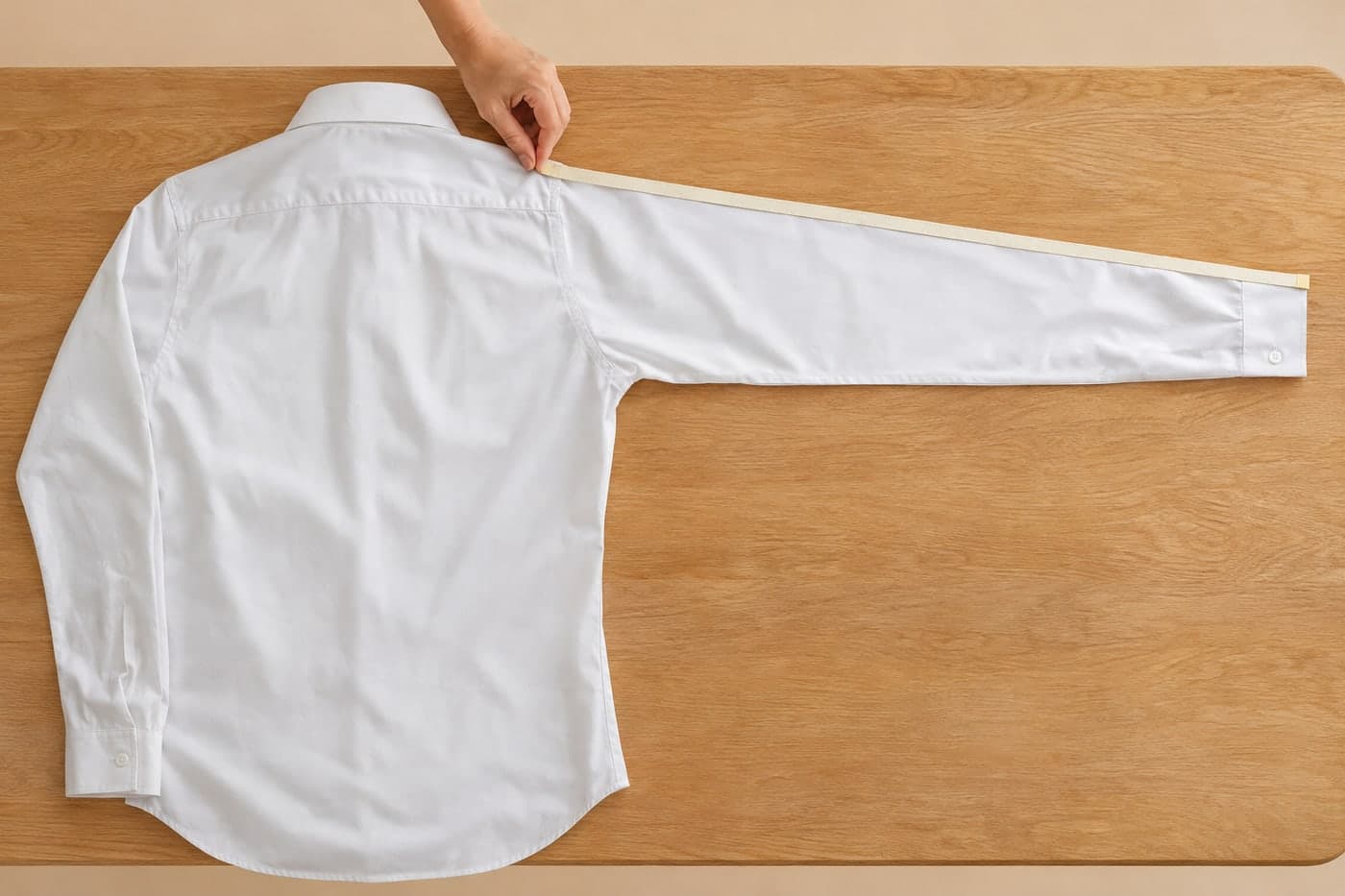
- Button the front and the cuffs. Lay the shirt face down on a table and pull one sleeve out straight from the body. Smooth it flat without stretching it.
- Shoulder method. Measure from the shoulder seam along the top of the sleeve to the end of the cuff.
- Center back method. Start at the center of the back, just below the collar, and run the tape to the shoulder seam. Hold it there, pivot, and follow the sleeve to the end of the cuff.
A shirt within about 1.3 cm (half an inch) of yours is a match: that is the tolerance Proper Cloth accepts on its own sleeves.
Converting one method into the other
The difference between the two numbers is half the shirt's back shoulder width. A worked example:
- Your shirt measures 46 cm (18 inches) across the back, shoulder seam to shoulder seam. Half of that is 23 cm (9 inches).
- A European chart lists a standard sleeve of 64 cm, measured from the shoulder seam.
- 64 + 23 = 87 cm, or 34.25 inches. That is a US 34/35 sleeve.
- Going the other way, a US 35-inch sleeve (89 cm) on the same shoulders is about 66 cm from the seam.
Sleeve length chart by shirt size
We compared four published men's shirt charts. They follow the same pattern and still disagree by more than an inch at the same letter size, so the measurement matters more than the label.
| Size | Zappos guide | Mizzen & Main (with height) | Cutter & Buck | UNTUCKit | Range in cm |
|---|---|---|---|---|---|
| S | 32 to 33 in | 32.5 to 33 in (5'8") | 32.5 to 33 in | 33 to 34 in | 81 to 86 cm |
| M | 33 to 34 in | 33.5 to 34 in (5'10") | 33 to 33.5 in | 33.5 to 34.5 in | 84 to 88 cm |
| L | 34 to 35 in | 34.5 to 35 in (6'0") | 33.5 to 34 in | 34.5 to 35.5 in | 85 to 90 cm |
| XL | not listed | 35.5 to 36 in (6'4") | 34 to 34.5 in | 35 to 36 in | 86 to 91 cm |
| XXL | not listed | 36 to 37 in (6'6") | 34.5 to 35 in | 35.5 to 36.5 in | 88 to 94 cm |
Cutter & Buck states that it measures from the center back of the neck. The others give no diagram, but their numbers sit in the same range. Tall sizes add 2 to 3 inches (5 to 8 cm) at UNTUCKit and Mizzen & Main. Height is only a rough guide, since arm length varies between people of the same height.
Where the sleeve should end
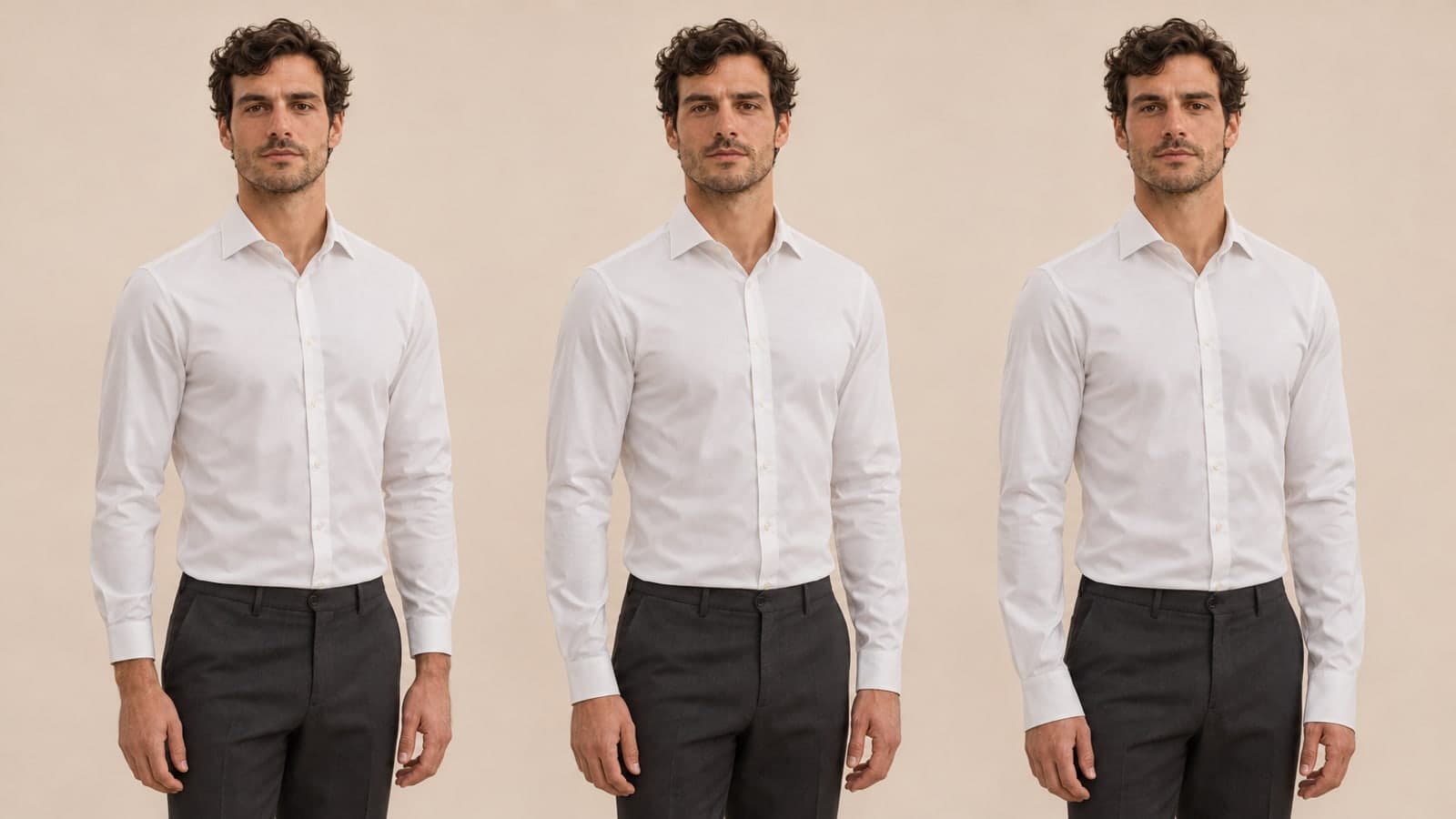
Check with your arms hanging relaxed at your sides, then bend your elbow. Left to right above: too short, right, too long.
| Garment | Arms relaxed, the sleeve ends |
|---|---|
| Dress shirt | Just past the wrist bone, at the base of the hand, and still at the wrist when you bend your elbow |
| Suit jacket or blazer | At the wrist bone, showing 0.5 to 1.5 cm (1/4 to 1/2 in) of shirt cuff |
| Overcoat or trench | Longer than the jacket, covering both cuffs, near the base of the thumb |
| Sweater | At the wrist bone; onto the back of the hand is too long (Peter Manning) |
If a shirt cuff slides down over your hand, the cuff may be too wide rather than the sleeve too long. Kwan's fix is to close the second cuff button where there is one.
For the rest of the shirt checks, from collar to cuff width, see how a dress shirt should fit.
How much shirt cuff should show under a jacket
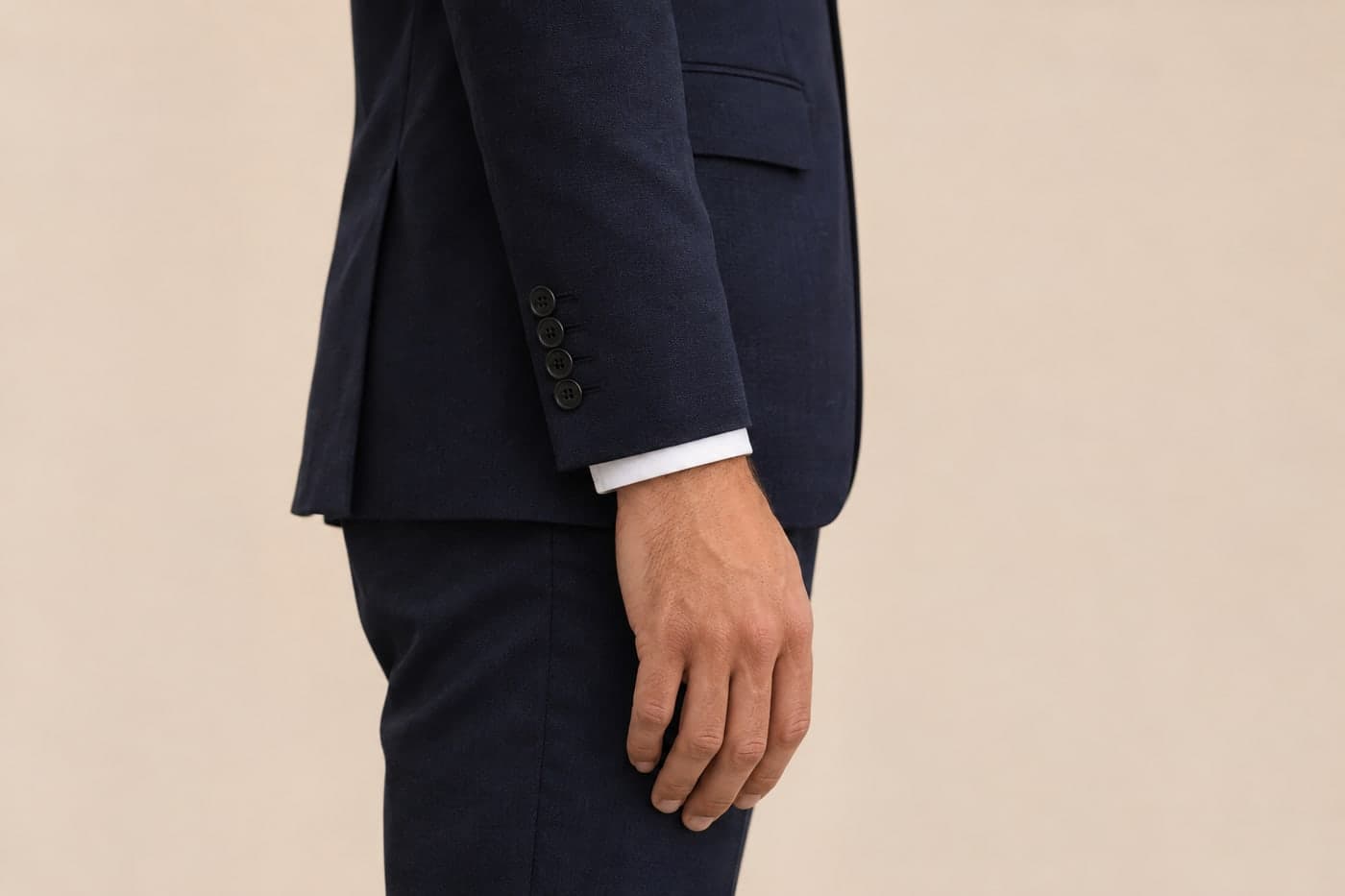
About 1 cm, or a quarter to half an inch, with your arms at your sides. The published advice agrees closely:
| Source | Shirt cuff showing |
|---|---|
| Proper Cloth | 0.25 to 0.5 in standard, never more than 1 in |
| The Black Tux | 1/4 to 1/2 in |
| Ron & Rich | 6 to 12 mm |
| Articles of Style | 1/2 in; up to 3/4 in for shorter arms; 3/4 to 1 in with formalwear |
The cuff showing is not only for looks, Kwan points out. Shirts are washed after every wear and jackets are not, so the shirt cuff takes the wear and dirt at the wrist instead of the jacket sleeve.
What a tailor can shorten or lengthen
- Dress shirts. Shortening is routine: the tailor removes the cuff, cuts the sleeve and sews the cuff back on. Lengthening barely works. The only spare fabric is the seam allowance inside the cuff, and tailors in a StyleForum thread put the gain at about 0.6 cm (1/4 inch) at most. Buy shirts long, never short.
- Jackets with closed buttons. Shortened or let down at the cuff. The buttonholes are unpicked, pressed out and the buttons moved, as Downtown Tailoring shows, and the lining is cut by the same amount. Letting down uses the fabric folded inside the hem, which that tailor says is usually about 4 cm (1.5 inches).
- Jackets with working buttonholes. The cut buttonholes fix the cuff. Proper Cloth puts the limit at 1.3 cm (half an inch) shorter or 1.9 cm (three quarters of an inch) longer. Beyond that the sleeve has to come off at the shoulder and be reset, which costs far more.
- Coats. Shortened from the cuff, with straps and buttons moved.
Prices and the full list are in what a tailor can fix.
How to measure sleeve length for women
Women's charts use both methods too. Stenstroms measures women's blouses, knitwear and blazers from the middle of the neck, the same as its men's shirts, while jacket charts and some shirt charts start at the shoulder point. Check the diagram before you compare numbers.
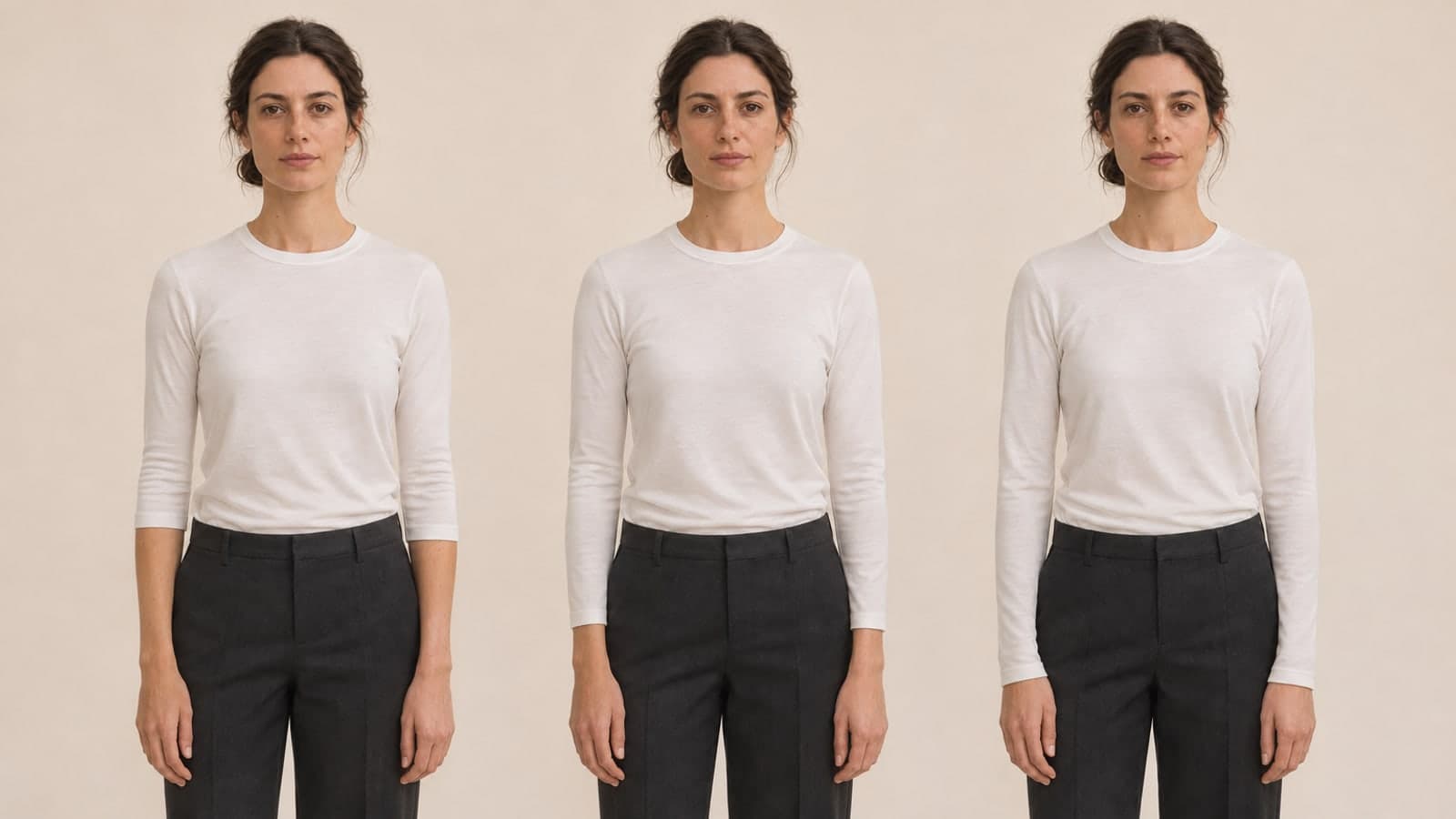
Two cases where the shoulder method fails: dropped shoulders, where the seam sits partway down the arm, and raglan sleeves, which run in one piece to the collar with no shoulder seam at all. For both, compare center back numbers, measured on your body and on the garment.
From shortest to longest above:
- Elbow length. Ends at or just below the elbow.
- Three-quarter. Ends about halfway between elbow and wrist.
- Bracelet length. Ends just above the wrist bone, so a bracelet or watch shows. Some shops use the name for three-quarter sleeves too, so check the photo or the number.
- Full length. Like a men's shirt, just past the wrist bone at the base of the hand.
To buy a cropped sleeve that ends where you want it, measure from your shoulder point down to that spot on your arm and compare it with the garment's sleeve, measured from the shoulder seam to the hem. For blouse and blazer checks, see how a shirt should fit for women.
FAQ
What does 15 32/33 mean on a shirt? The collar is 15 inches and the sleeve is made to fit arms that measure 32 or 33 inches with the center back method. Off-the-rack shirts often come in two-inch steps like 32/33, 34/35 and 36/37.
Is sleeve length the same as arm length? No. Arm length runs from the shoulder point to the wrist, the shoulder method. A dress shirt sleeve length adds the distance from the center of the neck to the shoulder, about half your shoulder width.
Should I round sleeve length up or down? Up. Cotton shrinks a little over the first washes, and a tailor can shorten a sleeve easily but can barely lengthen one.
What is a normal sleeve length for men? In the four charts above, a medium runs 33 to 34.5 inches (84 to 88 cm) and most sizes fall between 32 and 37 inches (81 to 94 cm), measured from the center back of the neck. Your own measurement beats the average: start with how to measure yourself for the rest of your numbers.
How Clothes Are Made: From Fiber to Finished Garment
Every step from fiber to finished garment, and the three places where fit is decided: the pattern block, grading between sizes, and factory tolerance.
How to Measure Inseam (and What It Means)
Three ways to measure your inseam and when to use each, how shoes and break change it, inseam by height from published brand charts, and what inseam means on shorts.
How to Shrink a Shirt, and How Much It Will Really Shrink
Wash it and tumble dry it until it is bone dry. What each fabric can lose in cm and inches, which method to use, why a full size is out of reach, and when a tailor is the better fix.